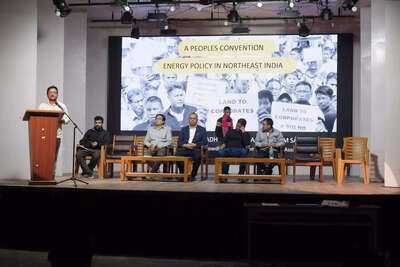
Guwahati, Jan 30: Over 15 organizations from the Northeast convened to endorse the Guwahati Declaration during a regional energy policy convention. They expressed concerns that existing energy policies are detrimental to the populace, exploitative, and threaten the rights of indigenous communities, their lands, and resources.
This event, organized by the Joint Struggle Committee for Protection of Land Rights, saw participation from representatives of Assam, Arunachal Pradesh, Manipur, and Sikkim.
The declaration emphasizes the need to safeguard human rights, land, water, and forests, claiming these resources are being appropriated unlawfully without local community consent.
Participants cautioned that the cumulative effects of ongoing and proposed hydropower, mining, and large infrastructure projects could lead to significant displacement of indigenous populations.
Speakers pointed out that energy policies in the Northeast are being implemented without sufficient social and environmental protections, despite the region's delicate ecology and diverse ethnic landscape.
The first panel of the convention focused on firsthand accounts of land dispossession, environmental harm, and livelihood threats stemming from large-scale energy and mining initiatives.
Pranab Doley, a convenor of the Joint Struggle Committee for Protection of Land Rights, described the declaration as a historic milestone, asserting that it represents a democratic affirmation of the rights of the people in the region.
He stated, "The framework established by the Guwahati Declaration will empower indigenous communities to safeguard their resources while pursuing development on their own terms."
Another convenor, Subrat Talukdar, warned that the ongoing push for 'anti-people' projects by both central and state governments could displace indigenous communities from their ancestral lands.
He alleged that influential corporations, supported by political agendas, are gradually seizing control of the region's natural resources, warning that over 100,000 indigenous individuals could face displacement if current trends persist.
Human rights attorney Ebo Mili from Arunachal Pradesh highlighted the deterioration of law and order and the neglect of human rights in the quest for large energy projects.
He referenced Arunachal Pradesh's goal of generating 60 GW of hydropower, stating, "Such initiatives are being pursued at the expense of people's rights and shared natural resources."
The convention also reviewed the broader policy context, including Assam's Integrated Clean Energy Policy (2025–2030), which aims for nearly 17,000 MW of power generation by 2030 through solar, hydropower, and thermal energy.
Participants questioned the justification for aggressive energy extraction in the Northeast, noting that the total peak power demand across all eight northeastern states is under 5,000 MW.
Speakers criticized what they described as a neoliberal, corporate-driven development model facilitated by public-private partnerships, alleging that extensive land and resources have been allocated to large corporations, often with backing from international financial institutions.
They cited incidents like the Baghjan oil blowout, mining disasters in Meghalaya and Assam, and the risks associated with large dams such as Lower Subansiri and Teesta as evidence of the perils inherent in the current development approach.
The representatives collectively agreed on several demands:
- Full implementation of the Sixth Schedule in Assam, Meghalaya, Tripura, and Mizoram; Article 371(A) for Nagaland, 371(G) for Mizoram, and 371(F) for Sikkim, along with enforcement of Tribal Belts and Blocks in Assam.
- Repeal of the Forest (Conservation) Amendment Act, 2023, which exempts forest land within 100 km of international borders from statutory protection.
- Mandatory Environmental Impact Assessment (EIA) for renewable energy projects, including solar power.
- Mandatory Social Impact Assessment for all proposed and ongoing projects.
- Regular and transparent safety audits of all oil-sector infrastructure, including pipelines.
- Enforcement of Free, Prior and Informed Consent (FPIC) in line with UN guidelines and ILO conventions before any project in indigenous territories.
- Full implementation of the 70 percent people’s mandate in public hearings, along with fair compensation and rehabilitation under the LARR Act, 2013.
- Complete implementation of the Forest Rights Act, 2006, empowering gram sabhas and communities to decide on land and forest use.
- A complete ban on mining in Sixth Schedule areas where FPIC has not been obtained.
- An end to what the declaration calls “false green solutions” such as mega dams, mega solar parks, compressed biogas plants, and large pump storage projects in the Northeast.
- Immediate halt to privatization of the energy sector.
- Strict enforcement of 100 percent job reservation for project-affected people.
- Zero tolerance for human rights violations and attacks on human rights defenders and whistleblowers.
Contact to : xlf550402@gmail.com
Copyright © boyuanhulian 2020 - 2023. All Right Reserved.