“Months ago I stopped by and gave up because the line was over an hour long,” a person called Danielle wrote in a Google review.
When she returned in mid-December, arriving 20 minutes before opening time, she still had to wait more than an hour to be seated.
Banh Anh Em was opened in April 2025 by Ton Thi Hong Nhu, then 35, from Buon Ma Thuot City in Vietnam’s Central Highlands.
In less than a year it earned a place on the Michelin Guide 2025 Bib Gourmand list for establishments offering good food at affordable prices.
Customers line up at banh mi shop Banh Anh Em in New York before the doors open. Photo courtesy of Ton Thi Hong Nhu |
The shop is not the only place in New York serving banh mi, but it quickly drew attention after opening. The media reported on the hours-long lines, and Michelin’s recognition further confirmed its appeal.
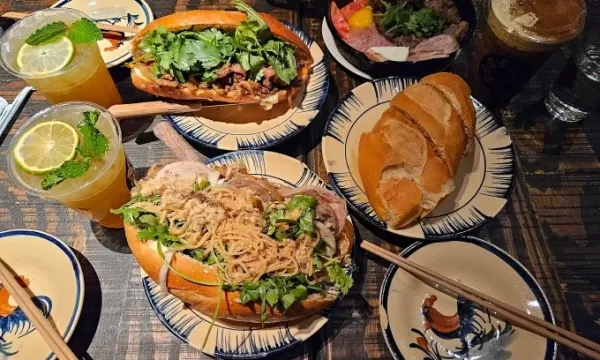
Michelin praised the preparation and flavors. The banh mi is noted for its crispy crust and hot fillings, while the menu also includes classics such as pho, rice rolls Cuon cake and crispy pancake banh xeo.
Behind the success lies a decade of experience in the food and beverage industry for Nhu.
She arrived in the United States in 2012 with just US$100 in her pocket after graduating in restaurant and hotel management in Vietnam.
During her first five years in New York she worked at every job imaginable, from dishwasher to bartender. She struggled to adapt, feeling isolated and at times battling depression.
In late 2012 she began teaching herself how to cook Vietnamese food. The kitchen in her apartment became a place of healing. Two years later she and her business partners took over a broken-rice eatery named Com Tam Ninh Kieu in the Bronx.
In 2022, at the height of the Covid pandemic, she opened Vietnamese Shop House on the Upper West Side.
While many restaurants were shutting down, she chose to operate pop-ups instead. Customers queued along the sidewalk, keeping their distance to order food through a window. This turned the spot into a social media and press sensation.
After more than 10 years in business and traveling across the U.S., Nhu noticed the contrast: people were willing to pay premium prices for Japanese or Italian cuisine, but Vietnamese, especially pho and banh mi, was labeled as cheap street food.
She points out: “To make a proper bowl of pho or banh mi takes more effort than many Japanese or Italian dishes. Just fermenting the dough and making the bread takes a full day.”
Banh Anh Em was created to challenge this perception. Her goal has been to spread respect for handcrafted processes and honor the beauty of Vietnamese cuisine.
Nhu spent more than two years studying bread-making techniques, learning from bakers in Vietnam, France, Denmark, and Japan before returning to New York to experiment and refine her own recipe.
New York’s hard water plays a role in achieving the Vietnamese-style crust, she says.
Research into food chemistry shows that the city’s water has stable mineral and calcium levels, qualities favored by pizza and bagel makers.
Those minerals nourish the yeast and strengthen the gluten structure. During baking, the gluten allows the bread to expand, creating the thin, crispy crust and fluffy interior of Vietnamese banh mi.
Unlike industrial baking, the shop ferments its dough overnight and bakes just 20 minutes before opening. Bread is baked in batches throughout service to ensure freshness. Every component, from pickles to fillings like charcoal-grilled beef or Hai Phong-style pate is prepared in-house, with no industrial ingredients brought in.
Banh mi options at Banh Anh Em in New York. Photo courtesy of Ton Thi Hong Nhu |
Everyday the shop sells around 200 sandwiches at an average price of $15. Nhu says the price reflects New York’s labor costs and the time needed to prepare each batch, and, while it is double the typical price, it is the lowest she can set.
“If we used machines, it would take only a few hours. Doing it by hand is a creative and meticulous process.”
Staffing remains one of the biggest challenges in the F&B industry, especially for making things by hand. Nhu aims to make the shop a second home for her employees, most of whom are immigrants and Vietnamese nationals.
“To build a healthy community takes a lot of effort,” she says.
She spends up to 15 hours a day in the kitchen alongside her team.
Without machinery, the kitchen relies on human strength. She calls her ethnic Vietnamese cooks, such as Hang and Tuyet, artisans.
The menu changes depending on the availability of ingredients, but always has two to four signature items.
The place often sells out early.
When it first opened wait times were 30 – 60 minutes. Since October weekend lines have grown to two or three hours.
Nhu tried delivery but was forced to stop because dine-in demand was too high. However, she says delivery or takeaway could return if the kitchen can handle it.
She says most customers are Vietnamese-Americans, other ethnic Asians and students living away from home. But after media coverage more locals have started lining up.
Loi Truong, a Vietnamese-American, drove more than two hours from Central Jersey just to try the banh mi. He parked two blocks away and waited about 90 minutes for a table.
“The space is simple, the staff are friendly and professional, and the food is delicious,” he says.
“The portions are a bit small, but worth it. It’s definitely one of the Vietnamese restaurants I want to return to.”
Contact to : xlf550402@gmail.com
Copyright © boyuanhulian 2020 - 2023. All Right Reserved.