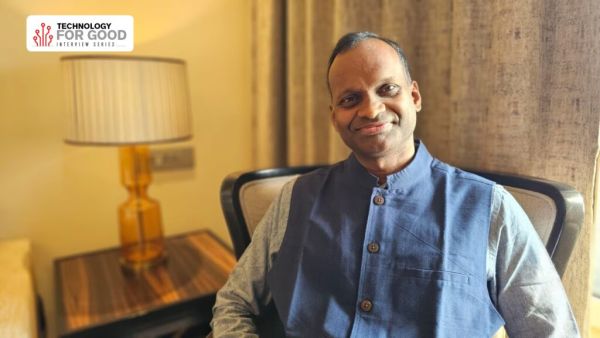
Dr Mohanasankar Sivaprakasam is a Professor at IIT Madras and heads the Healthcare Technology Innovation Centre (HTIC) as well as the Sudha Gopalakrishnan Brain Centre.
Established in 2011, HTIC is a leading med-tech innovation ecosystem that brings together around 40 medical institutions, industries, and government agencies to develop and deploy affordable healthcare technologies.
The Sudha Gopalakrishnan Brain Centre focuses on imaging entire human brains and is working towards generating the world’s most detailed cell-resolution human brain maps across the human lifespan, including for various brain diseases
A recipient of numerous awards, Mohanasankar was recently conferred with the Rashtriya Vigyan Puraskar for ‘outstanding and inspiring’ contributions in science and technology. He holds a B Tech degree from Anna University, an MS in Electrical Engineering from North Carolina State University, and a PhD in Electrical Engineering from the University of California at Santa Cruz.
Mohanasankar spoke to indianexpress.com on his research interests, the pathbreaking work being done by the centres he heads, the medtech ecosystem, and the challenges that startups face. Edited excerpts:
Venkatesh Kannaiah: Tell us broadly about your research interests.
Prof. Mohanasankar Sivaprakasam: I was trained in implantable medical electronics. During my PhD, I was fortunate to work on one of the most cutting-edge medical devices: electrically stimulating the retina to restore vision in blind patients. Because of that work, I had the opportunity to learn across many other fields: electrophysiology, biomaterials, and neurophysiology. Much of my understanding of neuroscience comes from that time.
I returned to India in 2008 and joined IIT Madras to do translational research. It means you do research, convert it into technology, and then translate that technology into products by working with industry or startups. Broadly, my work is in healthcare technologies. I measure the impact of our work by the number of patients we reach.
Story continues below this ad
Research-wise and publication-wise, our centre is one of the leading groups in India in the biomedical area.
Over the last five or six years, this direction has also been shaped by Kris Gopalakrishnan of Infosys, when he challenged us with the idea of whether we could create a ‘new science’ that would produce the technologies of tomorrow. This led to our work at the Sudha Gopalakrishnan Brain Centre at the intersection of neuroscience and engineering.
So today, human brain sciences and neurotechnologies form another major area of my research, alongside healthcare technologies.
Venkatesh Kannaiah: Tell us about the Healthcare Technology Innovation Centre, its history and journey.
Story continues below this ad
Prof. Mohanasankar Sivaprakasam: It’s now almost 15 years since we started. The medtech incubator began in 2017.
After returning to India, I wanted to work on medical devices and translate that work into the industry. But everyone was clear that such an ecosystem didn’t really exist in India at that time.
So we decided this couldn’t just be a lab. It had to be a centre. And not a centre focused only on technology. Healthcare is one of those messy sectors with many stakeholders: doctors, hospitals, regulators, industry, patients, and society at large. Technology is only one part of that system. So we created this centre to help anchor that ecosystem.
The centre started in 2011 in a small 3,000-square-foot space. Today, it is a 15,000-square-foot facility with both R&D and incubation.
Story continues below this ad
Our innovations have resulted in 14 commercially successful products, helping two crore patients in India and abroad. Our medtech incubator has incubated more than 60 healthtech startups.
Venkatesh Kannaiah: Could you tell us about some interesting innovations that have come out of the centre?
Prof Mohanasankar Sivaprakasam: The first product was a mobile eye surgical unit for cataract surgery, the first time an operating theatre was made mobile.
One of the leading causes of blindness in India is cataract. It’s shocking if you think about it, people going blind from something treatable. Yet the backlog for cataract surgery in India is very high.
Story continues below this ad
The issue isn’t just affordability. The real issue is access. India has a peculiar healthcare challenge: even when cost is manageable, access and quality remain barriers. Healthcare needs in India are a combination of affordability, access, and quality. Today, even in rural areas, people are aware of quality. That’s why people travel across states to places like AIIMS or Tata Memorial Hospital.
That question of access shaped our first product. We designed a fully functional mobile eye surgical unit. We then worked with the Ministry of Health to obtain special permission to conduct surgeries outside a traditional hospital setting. Around 40,000-45,000 surgeries have been performed using these units, all in remote rural regions across various states.
It was the first success. After that, a series of products followed.
We worked with Forus Health, a Bengaluru-based company, to address another major issue: not enough doctors in rural areas. India needs roughly
Story continues below this ad
100 million eye examinations per year, but we have only about 15,000 ophthalmologists, most of them in cities.
Together, we developed two products. The first is a portable, fully digital adult eye screening device that costs about one-third of existing systems. The intelligence is built into the software, allowing it to be operated by a non-expert. Images can be transmitted to a doctor for remote review, either in real time or later. This product, called 3nethra, is now used in around 2,500 locations across 40-50 countries.
The second product is 3nethra Neo, designed for screening newborns for retinopathy of prematurity (ROP). India has one of the highest numbers of premature births, and ROP can cause blindness if not detected early. Existing equipment is expensive, ranging from Rs 50 lakh to Rs 1 crore and requires specialists to operate. Even if the equipment were free, access would still be a problem because there are only a few hundred pediatric ophthalmologists in the country. 3nethra Neo addresses this gap and has now screened over four million infants, and is used globally.
We also developed systems for remote monitoring of newborns after hospital discharge — continuous monitoring of temperature and overall health. This was piloted in several districts in Tamil Nadu with very promising results, and expansion to other states is underway.
Then we moved into more complex territory: flexible endoscopy platforms. India currently imports nearly all its endoscopy systems: gastroscopes, bronchoscopes, colonoscopes, ureteroscopes. These are among the most complex medical devices: optics, electronics, lighting, safety, biopsy channels, irrigation channels, everything packed into a flexible tube.
We began this work around 2017-18. It took nearly five years of development, working with multiple companies. Today, a fully indigenous endoscopy platform has been created, and multiple products are now emerging from it. This is one of our biggest achievements.
From the incubator side, a few startups have also done very well. MediSim VR develops virtual reality platforms for surgical and medical training and is already commercial and growing globally.
Another company, C3 Med-Tech, has focused on ultra-portable eye screening using mobile phones with optical attachments. This is used in places where even portable medical devices are hard to deploy due to cost or logistics.
Venkatesh Kannaiah: Tell us about your work at the Sudha Gopalakrishnan Brain Centre and its potential impact.
Prof Mohanasankar Sivaprakasam: In 2016-17, Kris Gopalakrishnan, an IIT Madras alumnus, began a conversation with us with a simple question: Can we do something truly cutting-edge in human brain science?
The idea was to create a new science that doesn’t exist today. And when new science is created, new technologies inevitably follow, either by directly advancing that science or by training scientific minds to think differently.
At that time, much of the field was focused on mouse brain mapping. That’s essentially the baseline of brain science today. The truth is, we still don’t have a detailed map of the human brain at the cellular level.
MRI can give images at the millimetre or centimetre scale. That’s useful if you want to see damage that has already occurred. But if you want to understand what is happening or what is going to happen, you need insight at the cellular and molecular levels.
The brain sits inside the skull, so we can’t directly see it. For any organ in the body, detailed visualisation leads to better understanding, better experimentation, and, eventually, better treatment. With that thinking, we asked: what is missing in human brain science? Many things, of course, but one major gap is that we don’t have a complete, high-resolution picture of the human brain across ages and diseases.
We decided to take this on. When we looked around, we saw that researchers were mapping mouse brains. A mouse brain is about one cubic centimetre. A human brain is over 1,000 cubic centimetres. That’s roughly a thousand times more complex.
It was clear we would need entirely new technology. This was a huge risk. In research, developing a new technology and using it to do new science is doubly risky, the technology itself might fail. But we chose to take that risk.
We inaugurated the centre in March 2022. Today, it is one of the world’s leading centres for human brain imaging. This is currently the only way to access the brain at that level of detail: by imaging the brain in sections under the microscope, then digitally reconstructing it. We are talking about mapping entire human brains, slicing them, imaging them, and digitally putting them back together. A highly complex task because we are capturing fine detail (half a micron) at a very large scale (100 billion cells) and at a volume of petabytes.
The first set of human brain maps was released formally in early 2025. They advanced the field by roughly tenfold compared to what existed before. This is the first such global effort in human brain sciences that India is leading, in collaboration with leading scientists and researchers from over 10 countries. Our work has received significant global visibility, including an editorial in the oldest neuroscience journal in the world with the title ‘India Gets a Seat at the Table of Human Brain Cartography’.
This was only possible through a deeply interdisciplinary approach: neuroscience, engineering, technology, medicine, and now large-scale computing.
These maps will be powerful, both as scientific tools and as technology platforms for a deeper understanding of the brain, and eventually contribute to earlier diagnosis and better treatment.
Venkatesh Kannaiah: Your thoughts on the medtech ecosystem in India. funding, talent, institutions, research, etc…
Prof. Mohanasankar Sivaprakasam: Compared to 15 years ago, things are much better. Without doubt, India now has several medtech companies. But their scale of success has been very limited.
I’m not talking about unicorn valuations. I mean becoming truly large companies in terms of revenue and market presence. Very few have reached that stage. Why hasn’t it scaled? Is it because the market isn’t there? No. The issue is more structural.
In India, public healthcare or government-funded healthcare accounts for roughly 60-70% of the healthcare volume. In value terms, private healthcare may appear larger, but the government absorbs many hidden costs like land and infrastructure.
Startups, by definition, have to build something new. That’s how they differentiate. But healthcare systems, both public and private hospitals, are inherently conservative. The patient usually doesn’t choose the medical technology; hospitals do. Unless hospitals begin adopting more homegrown healthcare innovations, startups can’t scale.
In medtech, much of the innovation ecosystem of incubators, grants and research is already government-funded. But demand creation is the missing piece. If you fund innovation but don’t create pathways for adoption, companies remain small.
We often say large companies stifle innovation. But in Indian medtech, the absence of large domestic companies is actually part of the problem. We need a few large players who can aggregate products, markets, distribution, and scale.
Normally, in other sectors, large companies acquire startups and help them scale. But this has barely happened in Indian health tech.
Venkatesh Kannaiah: Tell us about a few Indian-origin global medtech startups that have impressed you.
Prof. Mohanasankar Sivaprakasam: Twin Health is a company that essentially started out in India. One of our IIT Madras alumni was a key driver. They are working on reversing diabetes and major metabolic disorders using a digital platform, doing extensive measurements and using that data to guide and shape people’s health behaviour.
This is what scale looks like. Instead of building one hospital, two hospitals, or five hospitals, you build a digital system that can reach people anywhere and continuously shape outcomes.
Twin Health creates a ‘digital twin’ of a person’s metabolism and uses that to personalise interventions. That’s one example I find very impressive.
Another example is Innovaccer, founded by an Indian entrepreneur, and a large part of its engineering happens in India. It’s an AI-driven healthcare data company that works across the ecosystem — insurers, hospitals, providers, and patients. Healthcare is a long, complex value chain with huge inefficiencies, and companies like Innovaccer use data and AI to optimise it. Again, this shows the strength of Indian talent, but these companies are largely US-oriented in terms of market and scale.
A third example I’m particularly happy about is the indigenous MRI effort now underway in India by Voxelgrids. This is one of the first serious attempts to build an MRI system domestically. This is exactly the kind of deep-tech, hardware-driven innovation we need more of.
The companies we discussed — Twin Health and Innovaccer — are largely digital, data-centric platforms. But when it comes to medical equipment, we still don’t see many globally dominant Indian companies. That’s why I mentioned the MRI example of Voxelgrids. I would also say Forus Health has done very well, but we would like it to become a global brand.
Venkatesh Kannaiah: Tell us about one out-of-the-box idea that you are researching, and which you think will have an outsized impact?
Prof Mohanasankar Sivaprakasam: The work we’re doing on the brain is perhaps the most transformative. We are currently imaging human brains across the lifespan, from fetal stages to 100 years.
When we have detailed views of the human brain across the lifespan, from the second trimester to old age, the insights we can generate about different brain regions and structures, at cellular and molecular levels, will be extraordinary.
This will not only advance neuroscience as a field, but also help answer critical questions about how diseases progress. Degeneration doesn’t happen overnight. Understanding the gradual changes at fine resolution can have an outsized impact over the coming decades.
The impact will unfold in many forms: new knowledge, new technologies, new products, and a better understanding of how different brain regions function and change over time. Essentially, we are building what you could call an atlas of the human brain. And from such an atlas, many downstream advances will emerge.
So far, we have acquired over 350 human brains across the lifespan and across different conditions, including both neurotypical brains and those with various brain- diseases.
You asked whether the impact will be seen in years or decades. The maps and atlases themselves will be created over the next few years. But when the global community begins using these atlases to generate insights, that’s when pharmaceutical companies, device makers, and clinicians can build new approaches. That broader impact will unfold over decades.
Venkatesh Kannaiah: AI in health. What do you foresee?
Prof. Mohanasankar Sivaprakasam: Even if you look at healthcare as a whole, it is one of the most inefficient sectors. The value chain is extremely complex and chaotic. Simply improving these processes could create 10-20% efficiency gains, maybe even more.
Some tools are already emerging which are aimed at reducing administrative burden in healthcare. Administrative work is a huge component, easily 10-20% of effort, so reducing that can have a big impact. Then there are AI agents supporting workflows, AI-driven diagnostics, and imaging tools that can now detect abnormalities in scans with accuracy that is often more consistent and repeatable than humans.
AI is also being used for drug discovery and predictive analytics. One area that particularly impresses me is disease prediction using non-medical measurements.
There was a recent study that looked only at sleep patterns. Based just on sleep data, they were able to predict risks for cardiac and other conditions with surprisingly high accuracy. Imagine that: using everyday behavioural or physiological signals, not traditional medical tests, to predict and prevent disease. That’s very powerful.
After all, none of us wants to go to the hospital unless we have to. If health insights can come from passive, non-clinical data — how you sleep, how you walk, how you move — that becomes highly scalable.
Of course, many such approaches are still at the pilot stage. The hard reality is that healthcare providers are fundamentally conservative. Healthcare systems are slow to change. It’s also a very long and complex value chain, which slows adoption.
Venkatesh Kannaiah: You seem to be wearing many hats: running an academic research group, large projects, R&D centres, industry collaborations, startup incubation, etc.
Prof. Mohanasankar Sivaprakasam: My mission is to develop impactful healthcare technologies out of India that are of global quality. All of the activities are connected pieces, directed towards it.
Contact to : xlf550402@gmail.com
Copyright © boyuanhulian 2020 - 2023. All Right Reserved.