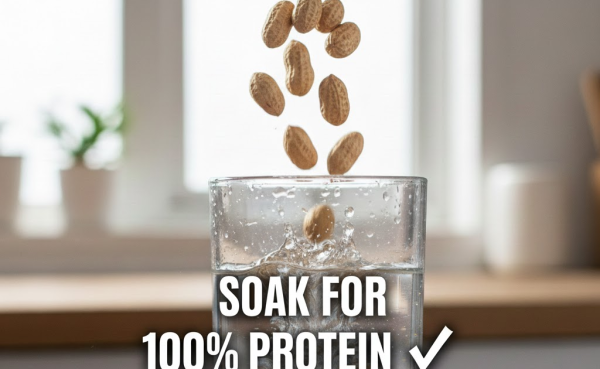
Is Your Peanut Snack Actually a Waste of
Protein? The Science of Soaking 
We often call peanuts the “poor man’s
almond,” but what if I told you that most of us are eating them in a way
that prevents our body from getting any real nutrition?
If you are a health-conscious person who
loves snacking on raw peanuts you need to read this. Science shows that **raw
peanuts might be blocking your protein absorption.
Is Your Peanut Snack Actually a Waste of Protein? The Science of Soaking
We often call peanuts the “poor man’s almond,” but most of us are eating them in a way that prevents our body from getting real nutrition. If you are a health-conscious person who loves snacking on raw peanuts, you need to understand the science of what happens when you soak them.
Based on a detailed study published by the National Institutes of Health (PMC6406428), soaking peanuts is not just about making them softer; it is about a chemical transformation that turns a simple snack into a nutritional powerhouse.
The Hidden Anti-Nutrient Barrier
Nature protects peanuts with compounds like Phytic Acid. Think of these as a “lock” that prevents your body from absorbing essential minerals like Iron and Zinc. Eating raw peanuts means you are only getting a fraction of the nutrients available. The science is clear: Soaking “unlocks” these nutrients, making them bioavailable for your body to actually use.
A Massive Boost in Antioxidants
One of the most significant findings in the PMC research is the impact of water on a peanut’s antioxidant levels. The study found that soaking and the early stages of germination (sprouting) significantly increase the Total Phenolic Content (TPC). These antioxidants act like a cleanup crew in your blood, fighting inflammation and protecting your heart.
From Snack to Superfood
The research specifically highlights that as a peanut begins to “wake up” in water, its Flavonoid levels rise. The peanut is preparing to grow, and in that process, it creates a “defense shield” of nutrients that are incredibly beneficial for human health.
Better Protein Absorption
Raw peanuts contain Trypsin Inhibitors. These inhibitors interfere with your digestive enzymes, specifically the ones meant to break down protein. The research confirms that hydration helps manage the peanut’s complex structure, making the protein much easier for your gut to handle and absorb.
How to Eat Peanuts Correctly
To get the results mentioned in scientific literature, follow this simple routine:
Soak raw, organic peanuts for at least 6 to 8 hours.
Rinse them thoroughly to remove the released phytic acid.
Eat them in the morning or as a pre-workout snack for maximum energy.
By simply soaking your peanuts, you turn a cheap snack into a high-performance superfood that rivals expensive nuts like almonds and walnuts. Stop wasting your protein and start soaking your science.
The Hidden “Blockers”: Why Raw Isn’t Always
Better
Peanuts are packed with protein, healthy
fats, and fiber. However, like many seeds and legumes, they have a natural
defense mechanism. They contain **Trypsin Inhibitors**.
What are Trypsin Inhibitors?
Trypsin is an essential enzyme in our
digestive system that breaks down protein into amino acids so our muscles and
tissues can use them. Raw peanuts contain compounds that “inhibit” or
block this enzyme.
The result? You eat the protein, but your
body can’t “unlock” it. It simply passes through your system.
The Power of Soaking: Making Peanuts as Good as Almonds
The good news is that you don’t have to
stop eating peanuts. You just need to change *how* you eat them. By soaking
peanuts in water for **6 to 8 hours** (or overnight), you trigger a chemical
change:
1.Neutralizes Phytic Acid: Soaking removes
phytic acid, which otherwise binds to minerals like iron and zinc.
2.Deactivates Inhibitors: It “switches
off” the trypsin inhibitors, making the protein **30% more bioavailable.
3. Easier Digestion: Soaked peanuts are
much lighter on the stomach and don’t cause the bloating that raw peanuts
sometimes do.
Simple Guide: How to Get Maximum Nutrition
If you want to stop wasting your money and
start building health, follow these simple steps:
Step 1: Take a handful of organic, raw
peanuts.
Step 2: Wash them and soak them in a bowl
of water overnight.
Step 3: In the morning, discard the water
and rinse them again.
Step 4: Eat them as they are, or add them
to your poha or salads.
Pro-Tip: If you don’t like soaked peanuts,
**lightly roasting** them also helps in breaking down these anti-nutrients,
though soaking remains the gold standard for gut health.
The Bottom Line
Eating healthy isn’t just about *what* you
eat; it’s about *how* your body absorbs it. By simply soaking your peanuts, you
turn a cheap snack into a high-performance superfood that rivals expensive nuts
like almonds and walnuts.
Stop wasting your protein. Start soaking
your science!
One of the most common myths in the world of nutrition is that peanuts increase cholesterol and cause inflammation. Many people avoid this affordable superfood because they fear it will clog their arteries or trigger heart issues. However, when we look at the clinical data from institutions like the National Institutes of Health (NIH) and PubMed, the reality is exactly the opposite.
The Cholesterol Myth: Plants vs Animals
The first and most important fact to understand is that cholesterol is a sterol that is produced only by animals. Plants do not have the biological machinery to produce cholesterol. Therefore, whether you eat them raw, roasted, or soaked, peanuts contain zero cholesterol. If you are worried about your lipid profile, plant-based proteins like peanuts are actually your safest bet.
How Peanuts Actively Lower Your LDL (Bad Cholesterol)
Peanuts do not just “lack” cholesterol; they actively help you lower it. They are rich in monounsaturated and polyunsaturated fatty acids, particularly oleic acid, which is the same healthy fat found in olive oil. According to research published in the Journal of Food Science and Technology (PMC4711439), these fats help reduce the levels of Low-Density Lipoprotein (LDL) in the blood while maintaining or even increasing High-Density Lipoprotein (HDL) or “good” cholesterol.
The Secret Weapon: Phytosterols
Peanuts are one of the most concentrated food sources of phytosterols. These are plant compounds that are structurally very similar to cholesterol. When you eat peanuts, these phytosterols compete with cholesterol for absorption in the digestive tract. Because the body tries to absorb the phytosterols, it ends up absorbing less of the actual cholesterol from other parts of your diet. This competition is a natural way to manage your blood cholesterol levels.
Addressing the Inflammation Connection
Many people associate peanuts with inflammation because of their Omega-6 fatty acid content. However, the science does not support this fear. Clinical studies (such as those found in PubMed reference 11444456) have shown that regular nut consumption is actually associated with lower levels of C-reactive protein (CRP), which is a key marker of inflammation in the body. The fiber, antioxidants, and the amino acid arginine found in peanuts work together to keep the lining of your blood vessels flexible and healthy.
Conclusion: A Heart-Healthy Superfood
The evidence is clear: peanuts are a heart-healthy food that can protect you against cardiovascular disease. They provide high-quality protein without the cholesterol found in meat or dairy. By soaking them to remove anti-nutrients (as discussed in previous posts), you unlock a nutritional powerhouse that supports both your muscles and your heart.
Contact to : xlf550402@gmail.com
Copyright © boyuanhulian 2020 - 2023. All Right Reserved.