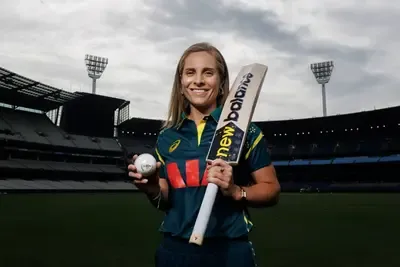
History unfolds. Sophie Molineux has been appointed Australia's all-format captain, succeeding the legendary Alyssa Healy, who retires in March 2026.Although Molineux has proven herself as an orthodox left-arm spinner, a tenacious middle-order batter internationally, there is much little known about her story between Bairnsdale and the national captaincy.
She is only 28 and she is not just a tactical leader, but a survivor who overcame the most demanding mental and physical challenges of the cricket world. Her rise, after being sidelined 858 days due to disabling injuries to the top of Melbourne Renegades, is a triumph of character over ability, as well as talent. With a captaincy against India in February 2025 and the 2026 T20 World Cup imminent, it is imperative to find out the face behind the Baggy Green when it comes to the future shape of Australian cricket.
10 Little-Known Things about Sophie Molineux
1. Talent-Spotted Early at Just Ten Years Old
View this post on Instagram
A post shared by Sophie Molineux (@sophiemolineux)
Before household recognition arrived, Sophie's exceptional ability was unmistakable. This occurred when she was very young at the age of ten when John Harmer, who is the former coach of the Australian women's team noticed her talent and realized that she was talented at a very tender age.
This child impressed Harmer so deep into his sense of the innate endowment of nature, that he was her special preceptor, and spent years in pointing out the rules of technical foundation, which ultimately brought her into the world of international success. This early detection was life changing. The majority of cricketers grow in the traditional ways; Sophie used to get the elite coaching since she was a child and this helped her grow exponentially.
And the mentorship of Harmer was not simply teaching skills, but teaching mental constructs on how to cope with pressure, how to comprehend game scenarios and how to focus when facing examination. Ten years of mentor and student produced the cricketing savvy Molineux shows nowadays. Australian cricket could have simply become one of the lesser-known talents or had been harshly developed without the intervention of Harmer at such a young age, essentially changing the course of her career.
Also Read | Most Runs for Australia as Openers in ODI & Champions Trophy History
2. A "West Bairnsdale" Prodigy
View this post on Instagram
A post shared by Sophie Molineux (@sophiemolineux)
Country roots define Sophie Molineux. Fiercely proud. Fiercely proud. She was brought up in Bairnsdale, which is not metropolitan Melbourne, but in a regional area, so she often had to play in local clubs as the only girl in teams where boys played. Her A-grade debut with West Bairnsdale turned into a legend in that close-knit community: four wickets in Nagle of St Mary as a teenager setting the stage of a young star in a very dramatic way.
Such upbringing in this country developed a resilience that is not there in the comfortable urban settings. Competing with more mature and talented male players, she acquired mental toughness and competitive instinct that has made her captain political team. Bairnsdale cricket was not posh-none of the trappings, very little of the resources, country expediency rather than city refinement.
But the lowly beginnings produced the next captain of Australia. She was taught the truest game of cricket; skill, will and community. That heritage of West Bairnsdale still serves as a landmark in her identity as it is a reminder of where she started even though she was playing in the top of the international cricket game and was leading her country into a battle.
3. The 858-Day Drought
 Image Source : Getty Images
Nightmare years. Between 2021 and early 2024, Sophie endured 858 agonizing days away from the Australian team—a horror injury run that nearly destroyed her career permanently. She was a sufferer of a stress fracture on the foot, which was followed by a catastrophic rupture of the ACL. Two catastrophic wounds that needed the use of a lot of rehabilitation, surgery, rebuilding of psychology.
At one desperate dark moment, she confessed that she was scared that she would never represent Australia again. Those suspicions were true, justified, frightening. Some athletes do not recover such losses: they are not only physically cured but also mentally injured, their confidence destroyed. Molineux endured the view of teammates playing as she couldn't, the monotony of rehabilitation, the psychological torture of not knowing when to expect a call and the call itself.
No match situation could put her character to the test as that drought of 858 days did. Her eventual coming back, and her eventual promotion as a captain, makes her story unusually inspirational. She survived, but not only that, she flourished, and this testament shows that resilience overcomes adversity when coupled with a strong determination and correct support systems.
4. Champion of Mental Health Advocacy
 Image Source : Getty Images
Courage manifests differently. In 2019 Molineux reached a very drastic conclusion: she left the cricket field in the meantime to take care of her mental health. Her frankness on the issue of psychological pressures of elite sport produced a watershed moment in the sport of Australian cricket that fundamentally transformed the discourse in terms of athlete well-being.
In the past, mental health battles were a secret, a stigma, a potential career killer had one revealed to the public. Those barriers were broken by the transparency of Sophie. She proved that the ability to take a break is not a sign of weakness, but it is a practice of self-preservation, a smart career organization. Her activism opened the way to both hers and others on the team and in the field to find assistance without a sense of shame or embarrassment.
The current friendlier cricket culture today would not have been the way it is without her ready to share her tackles openly on challenges that many athletes endure without airing out. The advocacy is not only personal but also leadership and through her platform, she has developed a systemic change that would ensure that future generations would not have to suffer needlessly due to avoidable mental health crises.
5. Mentor-Student Bond with Her Father
View this post on Instagram
A post shared by Sophie Molineux (@sophiemolineux)
Mark Molineux wasn't merely a supportive parent. He was himself a cricketing legend of the West Bairnsdale area, who became the life long guide to the girl and the main coach of Sophie during her early years. That father-daughter dynamic was truly something more than just a normal parent encouragement Mark taught Mark tactical discipline and country tough mentality that is now inherent to her leadership philosophy.
Being raised by a father who was a wit in the game of cricket offered more than approach: knowledge of the psychology of the game, the psychology of reading an opponent, the strategy of playing, decision-making in stress. Her whole career was based upon the bond they formed. Mark was already a visionary when anyone could be, cultivated it, basked in successes, and grieved losses.
Such a firm support system enabled Sophie to risk, experiment, fail safely and grow holistically. Now, when she is the captain of Australia, Mark can be found in all her choices, her communication approach, her toughness. Their relationship exemplifies how supportive family environments cultivate elite athletes—not through pressure, but through genuine mentorship rooted in love and cricket knowledge.
6. The "Katy Perry" Connection
 Image Source : Getty Images
At times, careers are characterized by surreal moments. Molineux can boast of being a part of the 2020 T20 world cup victory of Australia, a landmark of her career. However, there is one precious experience that even surpasses the win itself, and it is sharing that stage in MCG with pop superstar Katy Perry. Cricket collides with pop culture.
The best part of it all, 85,000 fans screaming, confetti dropping, world superstar performing, trophy hoisted is all that elite sport can offer besides statistics. The experience remains in the list of career highs of Sophie, showing that she appreciates the cultural influence of cricket. It was not only winning, but sharing that victory with the world in the most amazing celebration in history.
The Perry act was an indication of women cricket being mainstreamed, leaving niche status behind to the world. To a country girl of Bairnsdale, it was a final point of a journey of a country girl in clubs to international stardom, to obscurity to the stage with global stars of entertainment, to the moment of sharing with the world celebrities of Australian cricket achievements.
7. A Master of the "Red Ball" Lore
 Image Source : Getty Images
Modern cricket obsesses over T20s. Sophie Molineux? She loves Test cricket. Although modern society is obsessed with shortest formats, she is still passionate about longer-format matches in a very old-school way. Being a multi-day cricket player at a tender age in Bairnsdale, I learned the values of the subtleties of Test cricket, cricket strategies and patience.
She has joked several times that it is more natural to wear whites and play with red balls than any other type, which is a refreshing viewpoint of one who captains in the times of T20. This traditional cricketing love shapes her captaincy philosophy: technique and aggression, strategy and power, but not smashing boundaries, but making up innings.
Although having a thriving across formats, that Test cricket grounding gives her tactical richness that cannot be found in a player who has played his entire life on T20s. Her appreciation of the red ball relates her to the traditions of cricket so that all the modern audiences can remember that the soul of the sport is in longer formats despite the influence of commercial pressures that made the shortest formats dominant. It is honesty- loving the purest cricketing sport without a pretence.
8. Prolific Collector of Trading Cards
Out of the intensity of cricket, Sophie has in her way pursued unanticipated hobbies. She is a devoted sports trading card collector- an established hobby that gives mental relaxation to her in the stressful world of professional cricket. This pastime shows a different side of her character beyond athletic identity: a person who enjoys sports history and nostalgia, the systematic pleasure of collection.
Trading cards provide an escape from researching values, searching rare hits, and collecting, and the activities have nothing to do with pressure in cricket. A lot of high-profile athletes have trouble locating healthy food sources; that is what the collection offers to Sophie. It is mindfulness for the purpose of a hobby, mental health in means of fun distraction.
The fact that she was ready to talk about this interest in the open air further humanizes elite athletes, as it demonstrates to fans that captains and champions have their hobbies, their interests, and have their lives outside of their sport. And the fact that people can relate to her makes her a better leader, she is not a far-off superstar, but she remains a human being, accessible, who just happens to be in charge of Australia in the time in between trading cards.
9. The "Moon Boot" Reunion
Solidarity manifests powerfully sometimes. At the 2022 World Cup, Molineux, Georgia Wareham, and Tayla Vlaeminck were in the living room of their house, watching the final together, with all of them having suffered significant injuries, all having the same moon boots. They notoriously celebrated the win of Australia with each other three marginalized stars celebrating the success of their teammates and healing their own shattered hearts.
This was the bitter truth behind sport: the happiness of the team, and personal tragedy of the failure to play. The image of the moon boot reunion spread across the world and represented an image of endurance, friendship, a viewpoint without personal disappointment. Their unity and the captaincy of Sophie turned that image of 2022 into an even more heartfelt one now, however, as their collective fitness, and not only that, were restored, they came back and became even better, leading the next generation of Australia.
Those setbacks made them forever connected, and they have developed a sense of understanding between players who have had career-threatening setbacks. Those experiences make Molineux captainry experience empathy that cannot be experienced by always-healthy leaders, who know vulnerability and handle injured players in a caring manner since she has experienced that nightmare firsthand.
10. Historic WBBL Leadership
 Image Source : Getty Images
Sophie demonstrated leadership qualities in a spectacular manner before national captaincy set in. She steered Melbourne Renegades through the mediocrity of seventh place to their first ever WBBL title- the prettiest change for an organisation in a game of tactical skills and cultural leadership.
Her power to transform the mindset of a home team, reconstruct respect, inculcate winning infrastructures made her the main factor that made Cricket Australia see her as a natural successor to Healy. WBBL win was no chance but leadership masterwork. She took over struggling franchises, found areas of weaknesses, formulated strategies, empower her teammates and molded championship culture out of dysfunction.
The same skills are now applied to the Australian captaincy, which is the cohesive building of a team, tactical creativity, developing players, and being resilient to pressure. The WBBL title gave evidence that she was capable of leading, inspiring and delivering championships.
It proved the belief of Cricket Australia that Sophie Molineux has some unique traits that made great captains of good players: vision, communication, tactical acumen, and a championship character developed in the conditions of misery, success and never-give-up attitude.
Also Read | Top 10 Players with Most Runs in Women’s ODI World Cup History
Conclusion
Sophie Molineux's appointment isn't merely personnel change—it represents leadership forged through adversity, triumph, and unwavering resilience. She has seen the best and worst of cricket: victory at the World Cup and serious injuries that can destroy her career, her mental health issues, and national and global glory.
That all-encompassing experience makes them empathetic, tactical, psychologically-sensitive leaders that cannot be had by those who are privileged. Her story encourages millions of young cricketers in Australia and all over the world as she leads Australia to battle India in February 2025 and to the 2026 T20 World Cup. Being a prodigy of Bairnsdale and a national captain, Sophie is the personification of power over the impediments.
Her legacy has not been confined to statistics but rather to cultural change, the cause of mental health, showing that country kids can make good leaders in nations. Australian cricket is in a new era, and the leaders are confident that their captain appreciates struggle, importance of staying tough, and brings championships when they have a chance.
Contact to : xlf550402@gmail.com
Copyright © boyuanhulian 2020 - 2023. All Right Reserved.