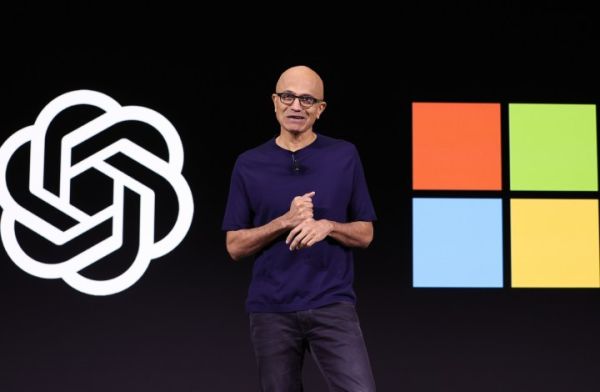
Microsoft’s latest quarterly earnings report, covering the period ending December 31, 2025, revealed a striking result: the tech giant recorded a $7.6 billion gain tied directly to its investment in OpenAI. This figure, noted as part of Microsoft’s overall net income, highlights how crucial the company’s AI strategy and partnership with OpenAI have become to its financial results even as investors grapple with broader concerns about spending on AI infrastructure and cloud growth.
For the quarter, Microsoft reported $81.3 billion in total revenue, representing a 17% increase year-over-year. This topped what analysts had expected, signaling continued demand for the company’s suite of software, productivity tools, and cloud services. On a GAAP basis, net income surged 60% to $38.5 billion, bolstered significantly by the OpenAI- gain. When excluding the accounting impact of the OpenAI investment (the company’s non-GAAP metrics), net income was still robust at $30.9 billion.
Chief Executive Satya Nadella described the results as indicative of Microsoft’s transformation into an AI-centric enterprise, with the company building “an AI business that is larger than some of our biggest franchises.”
The $7.6 Billion OpenAI Impact Explained
The $7.6 billion figure stems from how Microsoft accounts for its OpenAI investment and contractual obligations. After OpenAI restructured last year into a public benefit corporation, Microsoft renegotiated aspects of their collaboration. As part of that updated deal, OpenAI agreed to buy up to $250 billion worth of Azure cloud services over time, a commitment reflected on Microsoft’s books as “commercial remaining performance obligations” (RPO), a measure of contracted future revenue.
Microsoft’s total RPO soared to roughly $625 billion, up significantly from the prior quarter, with about 45% attributed to OpenAI’s commitments. That means the startup’s cloud purchases alone account for hundreds of billions in future contracted revenue, making it one of Microsoft’s most consequential customers.
This gain isn’t simple revenue in the cash-flow sense rather, it’s an accounting boost tied to the valuation change and contractual backlog associated with the OpenAI relationship. Still, it shows how deeply Microsoft’s fortunes are now linked to the AI lab’s growth and market trajectory.
Cloud Growth and AI Demand
Microsoft’s Intelligent Cloud segment, which includes Azure, grew by nearly 39% this quarter. Combined with another strong performance from productivity offerings like Microsoft 365, the broader cloud business topped $50 billion in revenue for the first time.
Cloud services remain central to Microsoft’s growth story, with AI integrations helping to drive adoption across enterprises. Azure’s performance beat expectations and reflects rising demand for scalable AI infrastructure. That said, some investors expressed reservations about the pace of cloud growth compared to previous quarters, which influenced market reactions after the earnings release.
While the financial headline was strong, Microsoft’s capital expenditures hit a record $37.5 billion for the quarter, a near-66% year-over-year increase. Most of this investment went into short-lived assets such as GPUs and CPUs to support expanding Azure capacity for AI workloads. This massive outlay is part of Microsoft’s effort to scale infrastructure for large models like those from OpenAI, a strategy with long-term potential but added near-term costs.
The company emphasized that this spending is critical to maintaining performance and competitiveness, though analysts and investors have raised concerns about how long it may take for such investments to pay off in consistent revenue growth beyond the OpenAI linkage.
Despite exceeding Wall Street estimates on revenue and earnings per share, Microsoft’s stock fell sharply in after-hours trading and the following sessions. Market watchers cited worries that the company’s cloud growth while strong showed signs of slowing slightly, and that the high levels of capital spending on AI could weigh on margins and free cash flow.
There’s also a broader concern that Microsoft’s increasing dependency on a few large accounts particularly OpenAI creates risk if those commitments change or slow over time. This has led to scrutiny from analysts even as many maintain long-term optimism about the company’s position in AI and cloud computing.
Microsoft’s latest results underscore a pivotal shift in its business model: AI is no longer experimental, it’s a major revenue and strategic driver. The OpenAI partnership, once a headline-grabbing bet, now contributes major financial outcomes and helps fortify Microsoft’s leadership in enterprise AI.
Yet the balance between investment and return remains delicate. Microsoft must continue scaling its cloud and AI capabilities while managing investor expectations around growth, costs, and competitive pressures from rivals like Google and Amazon.
Contact to : xlf550402@gmail.com
Copyright © boyuanhulian 2020 - 2023. All Right Reserved.