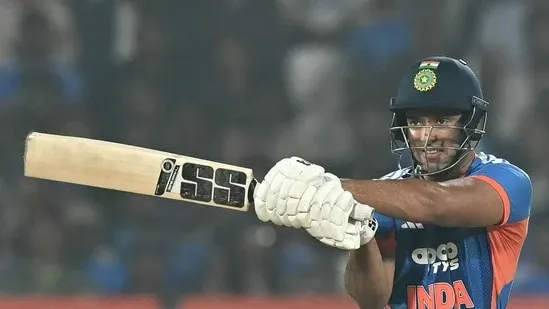
Shivam Dube wins the confidence of Sunil Gavaskar after 4th T20I blitz: ‘He won’t see himself only as a finisher’
In the fourth T20I between India and New Zealand, Shivam Dube didn't just rescue an innings, he made a statement about what he can be when the script demands it.
And that, more than the runs alone, is what Sunil Gavaskar latched onto on the Star Sports broadcast: a batter usually slotted to arrive late suddenly walking in earlier than planned and still choosing impact over caution.
Gavaskar's reading began with role and timing. Dube, he pointed out, is typically the kind of number six or seven who gets a short window with freedom of a settled line-up. This time, early wickets meant the entry point shifted, and with it, the pressure.
"I thought he grabbed the opportunity really well. As you said, when you bat at six or seven, you're probably getting three or four overs with a strong India batting line-up. But this time India lost early wickets, and he had to come in sooner. He showed intent from the very first ball - the first ball six was one of the longest you'll see, right into the second tier," said Gavaskar.
For Sunil Gavaskar, the first swing wasn't just a crowd-pleaser. It was the kind of early blow that changes the batter's internal question - from survival to "I belong here".
"When you strike a shot like that early, your confidence soars. He knows that if he connects, the ball is going into the stands because he's got that power, the swing, and the timing. It ended up being the third-fastest fifty for India, which is remarkable - you are talking about Yuvraj Singh, Abhishek Sharma, and now Shivam Dube," said Gavaskar.
It places Dube's knock in a very specific Indian T20 tradition: the innings that doesn't merely catch up, but tilts momentum in a burst. Gavaskar's framing also hints at why Dube's power-hitting works best when it's married to clarity - no overthinking, just immediate intent.
And then came the selection angle - the part that always sits beneath Gavaskar's praise. He stressed Shivam Dube's value is the multi-skill option, and the mindset shift that can follow an innings like this.
"The fact that he can also bowl a couple of overs makes him such a valuable player. And having come in earlier, he won't see himself only as a finisher anymore. He'll believe he can build an innings and finish too, especially in pressure situations," Gavaskar added.
Contact to : xlf550402@gmail.com
Copyright © boyuanhulian 2020 - 2023. All Right Reserved.