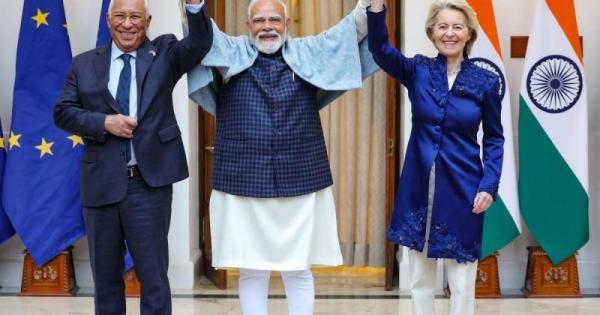
While Washington erects tariff walls that threaten to balkanize global supply chains, New Delhi and Brussels have forged a bridge spanning nearly two billion people and a quarter of the world’s GDP. The India-European Union Free Trade Agreement (FTA), finalized on January 27, 2026, amid the India-EU Summit in New Delhi, is no mere commercial pact. It is geoeconomic reinsurance in an era of escalating uncertainty. With bilateral trade already at €180 billion in 2024 (€120 billion in goods: EU exports to India €49 billion, imports €71 billion; plus €59.8 billion in services), official projections from the European Commission anticipate EU goods exports to India doubling by 2032, fueled by €4 billion in annual duty savings for European firms. Yet the deal’s intellectual elegance lies in its asymmetric complementarity: India’s vast, labor-abundant scale marries Europe’s technology-intensive capital, unleashing dynamic gains that transcend static tariff arithmetic.
This FTA dismantles barriers on 96.6 percent of EU exports to India and 97 to 99.5 percent of Indian exports to the EU by value, with phased implementations safeguarding domestic sensitivities. But to grasp its brilliance, consider the causal cascades it ignites. For India, textiles and apparel (current exports €6.975 billion: €2.457 billion textiles, €4.518 billion clothing) shed EU tariffs of 4 to 12 percent, yielding €558 million in immediate savings. This is not isolated relief: compounded by India’s wage advantages, Production-Linked Incentive schemes, and surging EU demand for sustainable fashion, it could redirect 5 to 10 percent of global fast-fashion value chains from rivals like Bangladesh or Vietnam, propelling a 20 to 30 percent export surge (€1.4 to 2.1 billion added by 2032) and generating 6 to 7 million jobs in rural heartlands.
Similarly, leather and footwear (€1.5 billion) escape 17 percent duties, saving €255 million and enabling 25 percent growth (€375 million more), while gems and jewelry (€3 billion) gain €120 million from 4 percent cuts, with 15 percent uplift (€450 million). In chemicals and plastics (€18.485 billion, including €8 billion pharmaceuticals), 12 percent average tariffs vanish, saving €2.24 billion and fostering 40 percent expansion (€7.4 billion) through deeper integration into European value chains. Think Indian APIs fueling EU drug innovation. Engineering goods and machinery (€19.312 billion) save €1.93 billion from 10 percent tariffs, with 50 percent projected growth (€9.7 billion) amplified by EU FDI inflows, accelerating endogenous productivity spillovers under “Make in India.”
Agriculture and marine products (€3.931 billion plus €1 billion marine) selectively benefit: 10 to 26 percent tariffs drop to zero on non-sensitive items, saving €491 million and adding €786 million by 2032, while embedded safeguards protect dairy and poultry, embodying Dani Rodrik’s “embedded liberalism”: openness tempered by social resilience. Services, India’s €33.8 billion export powerhouse (IT, telecom, business), evolve beyond barriers via professional mobility provisions, potentially adding €2 to 3 billion annually as streamlined visas unlock human capital flows.
Counterfactually, absent this deal, India risks over-reliance on volatile U.S. and Chinese markets; with it, annual duty savings of €6.6 billion pair with goods exports climbing to €110.7 billion by 2032 (€39.4 billion increase) and services growing €10 billion, yielding €12 to 13 billion in yearly economic advantage. These estimates, drawn from historical FTA elasticities (for example, EU-Vietnam’s 40 to 60 percent sectoral surges), underscore forward multipliers: EU green tech transfers could hasten India’s decarbonization, boosting long-run growth rates by 0.1 to 0.2 percentage points.
For the EU, the pact pries open India’s €3.4 trillion economy with unprecedented access. Machinery and electrical equipment (€16.3 billion) shed tariffs up to 44 percent, saving €3.26 billion and driving 60 percent growth (€9.8 billion by 2032), positioning firms like Siemens to embed in India’s infrastructure boom. Aircraft (€6.4 billion) gain €1.12 billion from 15 to 20 percent cuts, adding €2.6 billion amid aviation expansion. Automotives (€2 billion) see prohibitive 110 percent duties phased to 10 percent under a 250,000-unit quota, saving €1.2 billion and doubling exports (€2 to 3 billion more), especially for German-French EVs in India’s green pivot.
Chemicals and pharmaceuticals (€7.931 billion) save €1.19 billion from 15 percent averages, with 50 percent uplift (€4 billion); iron, steel, and plastics (€6.664 billion) gain €773 million and €2 billion growth. Agri-food (€0.792 billion): wines, spirits, olive oil, chocolate transforms from 150 percent tariffs to 20 to 40 percent on alcohol and zero on many processed goods, saving €317 million and doubling exports (€0.8 billion), delighting French vineyards and Italian exporters. Services (€26 billion EU exports) could swell by €3 to 4 billion via privileged access in finance and maritime. Miscellaneous sectors add €779 million savings and €1.3 billion growth.
In sum, the EU’s €4 billion duty windfall (up to €4.75 billion per some analyses) aligns with doubled goods exports to €98 billion by 2032 (€49.2 billion increase) and €10 billion services growth, delivering €11 to 12 billion annually. Geopolitically, it hedges U.S. mercantilism and supply-chain weaponization, while €500 million in EU funding over two years for Indian emissions cuts mitigates Carbon Border Adjustment Mechanism frictions, fostering a rules-based counterweight in multipolar Asia.
Challenges loom: ratification delays in the European Parliament, adjustment costs for displaced workers, enforcement of sustainability clauses. But the FTA’s architecture (surge safeguards, phased liberalization, AI-tech cooperation) ingeniously mitigates them, drawing on Ricardian comparative advantage evolved into dynamic, endogenous forms. In the 21st-century great game, where economic coercion supplants cooperation, this “mother of all deals” reaffirms that enlightened self-interest can prevail. Bridges, not walls, endure; partners, not sides, define victory. As ratification beckons, India and the EU have scripted a masterclass in strategic interdependence, one that could inspire a fragmented world to rebuild.
(Major General Dr. Dilawar Singh, IAV, is a distinguished strategist having held senior positions in technology, defence, and corporate governance. He serves on global boards and advises on leadership, emerging technologies, and strategic affairs, with a focus on aligning India’s interests in the evolving global technological order.)
Contact to : xlf550402@gmail.com
Copyright © boyuanhulian 2020 - 2023. All Right Reserved.