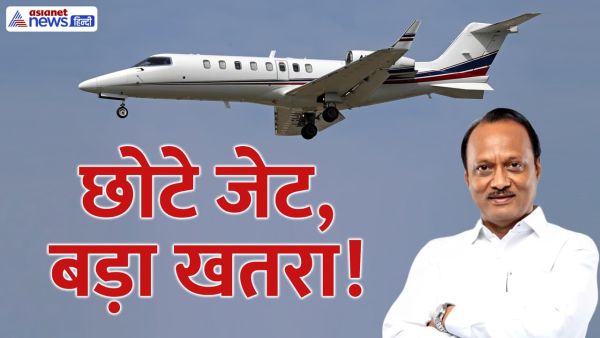
Small Aircraft Crash Reasons: Maharashtra Deputy CM Ajit Pawar has died in a plane crash near Baramati Airport. He was traveling from Mumbai in a mid-size private jet Learjet-45. Know why small jets are more dangerous?
Ajit Pawar Plane Crash Private Jets Risk: Wednesday morning started with a deep shock for Maharashtra. Five people, including state Deputy CM Ajit Pawar, died in a plane crash near Baramati Airport. The accident happened when Ajit Pawar was going from Mumbai to Baramati. The plane they were on was a mid-size chartered private jet Learjet-45. This painful accident has not only shaken the political circles, but has once again raised an important question related to aviation, are small and private jets more dangerous than big planes? Know what NASA's data says...
Investigation into Ajit Pawar's plane crash
According to senior DGCA officials, the investigation into this crash has now started at the technical level. The investigation team is analyzing the spread of the aircraft debris, direction of collision, speed at the time of landing, angle and geographical conditions of the crash site. High-resolution photography of the entire area is being done so that it can be understood at what angle the plane hit the ground. The real reason will become clear only after the data and technical analysis obtained from the black box, but initial indications are pointing towards some possibilities.
Why do private jets crash?
Aviation experts believe that one of the most common causes of private jet crashes is sudden engine or control system failure. During landing, the pilot has to balance speed, angle and height in seconds. If at this point there is a delay in engine response or the control system does not function properly, the situation can quickly get out of hand. This challenge increases further in aircraft like Learjet-45, because these aircraft are light and the pilot has limited time to correct the mistake.
What does NASA's data say?
According to the report of 'NASA-Ames Research Center', pilot error is an important reason in about 50% of the plane accidents occurring worldwide. Meaning, 1 out of every 2 accidents is due to human error. At the time of landing, if the speed is high or the angle is wrong, then the pilot should do a go-around i.e. take off again, but time pressure in VIP flights increases the risk. This does not mean that the pilot is inexperienced, but sometimes circumstances change so rapidly that a wrong decision becomes costly. The captain flying Ajit Pawar's plane is said to be experienced and he also had good experience of flying Learjet-45. But aviation experts also say that time pressure and schedule imperatives on VIP flights can force pilots to take additional risks. According to eyewitnesses, the plane was seen trying to rise again after reaching a height of about 100 feet before landing. This indicates that the pilot tried to take control of the aircraft at the last moments.
The biggest weakness of small jets
The weather is said to be clear at the time of Ajit Pawar's plane crash, but clear sky is not everything in aviation. Sudden changes in wind direction, low-level turbulence or air currents forming around the runway can destabilize small and light aircraft. Jets like the Learjet fly at lower altitudes and suffer wind effects more quickly than larger planes. The same reason was responsible for the 2008 Learjet-45 crash in Mexico City, when the wind waves created by a larger aircraft threw the jet off balance, killing 16 people.
Can runways also be responsible for plane crashes?
The condition of the runway is very important in any landing. If the runway is wet, has poor grip or is poorly lit, the aircraft may skid even at the correct speed and angle. Small airports also have limited runway length and modern safety systems, which further increases the risk. Initial reports suggest that the plane skidded off the runway, although this can be confirmed only after the investigation is completed.
Why are small private jets considered more deadly?
According to aviation experts, small and mid-sized jets are light, make frequent takeoffs and landings and often land at airports where facilities are limited. There is very little margin for error in these aircraft. While in big flights the pilot gets more time and room for improvement, in a small jet even a small mistake can turn into a major accident. This is the reason why accidents involving private and chartered jets appear more fatal in the statistics.
Contact to : xlf550402@gmail.com
Copyright © boyuanhulian 2020 - 2023. All Right Reserved.