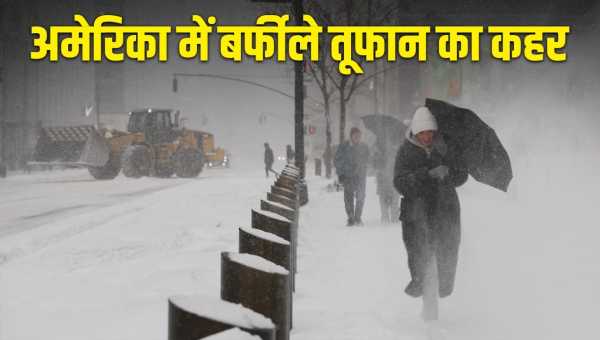
America is in the grip of a snow storm these days. So far, deaths of more than two dozen people have been reported and the lives of seven lakh people remained without electricity for several hours. This storm is an example of the fact that cold weather is not limited to just snowfall. It can paralyze power systems, transportation, health, and even emergency services. Heavy snowfall occurred in the northeastern US, while freezing rain and ice storms in the southern parts caused major damage by breaking trees and power lines.
Let us understand what is the process of formation of such storms? What is its science and how dangerous can it be? You will also learn about Ice Storm vs Snow Storm. Information about its danger and all the major aspects of prevention will also be available.
This storm is the story of a big system
In a huge country like America, when the bitter cold air of the Arctic region descends towards the south and at the same time warm and moist air collides with it, a powerful combination of energy and moisture is formed in the atmosphere. Due to this collision, a low-pressure system often develops, which appears in different forms in many states. Shows its effect. At some places there is heavy snowfall and at other places there is freezing rain. At some places, strong winds blow with sleet i.e. small grains of ice, due to which the windchill can drop to life-threatening levels.
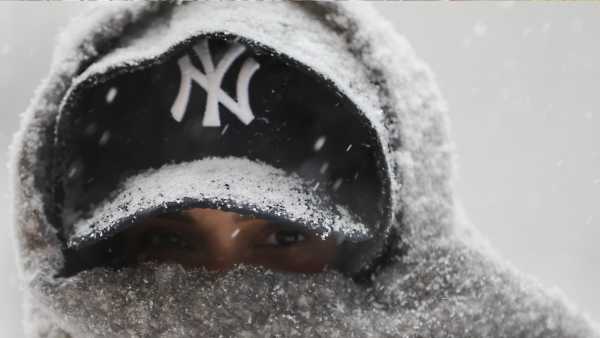
So far, more than two dozen deaths have been reported due to the snow storm.
According to reports, this storm recorded a foot or more of snow in many areas along about 1,300 miles from Arkansas to New England. Some places saw up to 20 inches of snow and windchill conditions around -32°C. New York City reported its heaviest snowfall in years, with Central Park reporting about 11 inches of snow.
What is the science of this storm?
To understand winter storms, it is important to understand five main concepts.
1- Pressure game: Why is low pressure powerful?
In a low-pressure system, air comes in from all sides and rises up. The rising air cools and condenses, forming clouds and causing rain and snow. When the temperature difference between cold and hot air is very large, the system can rapidly intensify, meaning the pressure drops further. With this the winds become stronger.
2- The fuel of moisture is the sea and the wind coming from the Gulf.
Cold air alone does not make snow; Ice requires moisture. Sources like the Atlantic or the Gulf of Mexico add moisture to the atmosphere. This moisture goes into the cold layer and forms snow, sleet, freezing rain.
3-jet stream and cold shock
The jet stream flowing high in the atmosphere influences the path and strength of weather systems. When large bends (waves) occur in the jet stream, Arctic air slides southward and the cold wave or snow system spreads.4-How is ice formed?
In clouds, especially when the temperature is below 0°C, water droplets can remain supercooled (liquid even when below 0°C). When they get seeds (Ice Nuclei) they make ice crystals. These crystals join together, grow larger and fall as snow-flakes. The snowflake-like structure and quantity depend on the temperature, humidity and air layers in the cloud.
5-Difference between sleet and freezing rain
This is very important to understand because ice storms often cause more damage than just snow. Sleet is a condition when snow forms at the top, melts in a warm layer in the middle to form rain, and then solidifies and falls as tiny snowflakes back into the cold layer below.
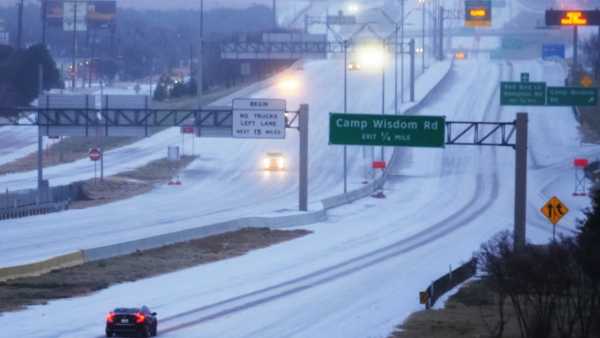
In Freezing Rain, the snow above melts and becomes rain, but the air near the ground is below 0°C. In such a situation, as soon as the drops fall on the ground, trees, wires, they freeze immediately and form a glass-like layer of ice (Glaze Ice). This same glaze ice can weigh down power lines and break them, bring down tree branches, and turn roads into skating rinks.
What are its real dangers?
Deaths in winter storms often result not from falling snow alone, but from accidents and secondary effects. Some deaths have been reported to be related to snowplow accidents, sledding accidents, and exposure to hypothermia. Even in New York City, many people have been found dead outside during extreme cold.
Hypothermia is a dangerously low body temperature, especially in the elderly, children, homeless people, or those without electricity/heating. In frostbite, skin and tissues start freezing, fingers, ears and nose are the first to be affected. Windchill causes the strong wind to rapidly snatch away body heat. You may feel colder than what the thermometer shows. Snow, black ice, and low visibility cause a large number of accidents. To avoid cold, people run generators, coal and gas heaters incorrectly, which increases the risk of poisoning by carbon monoxide (CO). Incidents of fire also increase due to temporary heating in the house. Falling of trees, breaking of transmission lines, freezing of water pipes, disruption of mobile networks are common.
Winter Snow Storm from New York to Dallas…
Hits Japan Hard…..
Stay safe everyone 🇺🇸🇯🇵🙏 #Snowstorm2026 pic.twitter.com/BbPVb7dMKa
— Muhammad Farooq (@mfarooqbukhsh) January 25, 2026
Heavy Snow vs. Ice Storm: Which Does More Damage?
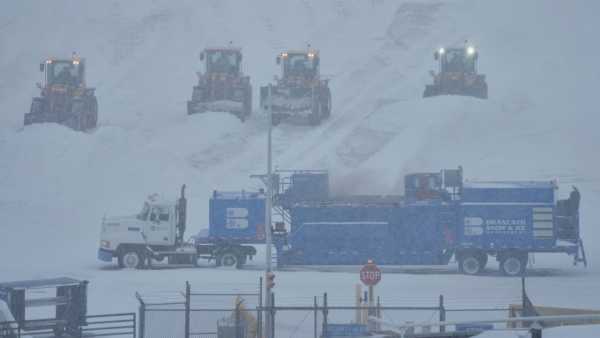
Everyone has losses. Traffic comes to a halt due to heavy snow. Flights have to be cancelled. Schools and offices have to be closed. Snow removal from roads has a huge cost. In case of ice storm (freezing rain) the situation is often more destructive. Because even a snow layer of 515 mm puts a lot of weight on the wires and trees. Its signatures are long power outages, falling branches, and dangerous slippery roads. That is why sometimes in the southern states, where heavy snowfall is less, ice storms prove to be relatively more destructive. Because the preparations, equipment, and networks there may be less suited to ice loads.
Impact on aviation and supply chain
In such storms, flights are extensively affected due to airport runway de-icing, visibility, and aircraft safety. According to reports, thousands of flights have been delayed. Has been cancelled. Its impact not only affects passengers but also cargo, delivery of medicines and essential goods and the retail supply chain.
According to media reports, more than eight thousand flights were delayed or canceled in America last Monday. A day before that, i.e. on Sunday, it has been said that 45 percent of America's flights will be cancelled. It is natural that in this situation the entire supply chain would have gone haywire.
Is climate change related to this?
It is not scientifically appropriate to say that any one storm was directly caused by climate change. Because weather is a phenomenon and climate is a long-term trend. But the broad scientific understanding is that a warming world increases the atmosphere's ability to hold moisture, which in many situations could increase the likelihood of heavy rainfall and heavy snow. Also, the tendency for extreme weather has increased in many areas. However, things like region, ocean patterns and jet streams also play a big role.
What to do in such a storm?
In case of such warning, keep 23 days of water, dry food, torch, battery, power bank for home. Keep heaters, fire-places safe; Take care of exhausting smoke. If there is a generator, never run it inside the house or in the garage. To prevent pipe freezing, it is considered appropriate to sprinkle light water. Do not travel unnecessarily. Keep blankets, water, snacks, first-aid, and chargers in the car. Increase braking distance. Consider black ice an invisible threat. If you ever get stuck outside, wearing dry clothes, wearing layers, keeping the body dry, and protection from the wind can be helpful.
This storm is not just snow, it is a multi-hazard event
This winter system of America appeared in many forms simultaneously. Heavy snow in the Northeast, freezing rain and long power outages in the South, along with deadly cold and travel disruptions. This is why winter storm is considered a multi-hazard disaster. In this, weather, infrastructure, health, and human behavior all together increase the risk.
Contact to : xlf550402@gmail.com
Copyright © boyuanhulian 2020 - 2023. All Right Reserved.