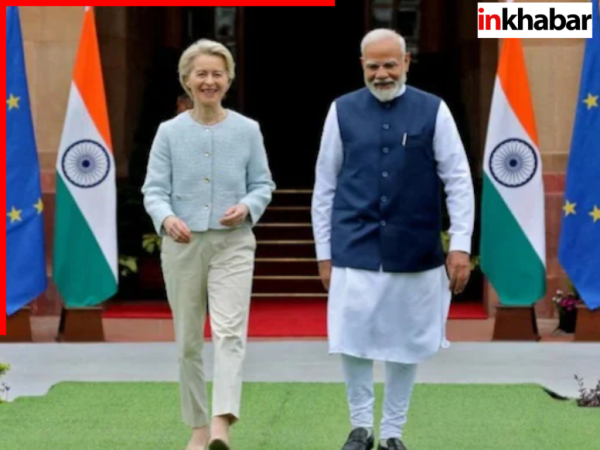
India-EU Trade Deal: Import duty will be reduced on textiles, footwear, cars and wine; Know what other things will be dealt with?

India EU Trade Deal: Cuts in import duty on labour-intensive sectors like textiles and footwear, as well as cars and wine, are expected to be included in the free trade agreement (FTA) between India and the 27-nation bloc European Union (EU), which is scheduled to be announced on January 27, according to a PTI report quoting people aware of the development. He told that with this agreement there is a possibility of simplifying the rules in different service sectors.
India has advocated for zero-duty access to its labour-intensive sectors, including textiles, leather, clothing, gems and jewellery, and handicrafts. This has been a key demand in all of India’s free trade agreements, and has been successfully met in every case, including the agreements with the UK, UAE and Australia, the report said.
Meanwhile, the EU is pushing for lower tariffs on its cars and alcoholic drinks like wine. India has offered quota-based tariff reduction for automobiles in its trade agreement with the UK. Additionally, wine has been included in trade agreements with Australia and New Zealand. India has given duty exemption on Australian wine for a period of 10 years.
In September last year, Commerce Secretary Rajesh Aggarwal, who was a special secretary at that time, had said that the proposed trade agreement with the EU would open up significant opportunities for the domestic auto sector to increase exports and establish new collaborations with major automobile companies of the 27-member bloc, the report said.
India-UK Trade Agreement
In the India-UK trade agreement signed in May 2025, there was a proposal to reduce the tariff on automotive imports under quota from 100% to 10% for both the countries.
India has included adequate safeguards in the FTA with the UK to protect its sensitive sectors. In the automotive segment, import duty will be reduced over a period of 10-15 years.
Details of India-EU FTA
On January 27, India and the European Union are expected to announce the conclusion of negotiations and the finalization of a free trade agreement. The report said that this agreement will be finalized after 18 years of negotiations, which started in 2007.
The tariffs imposed by the EU on Indian goods are around 3.8%; However, labour-intensive sectors attract around 10% import duty. India’s weighted-average duty on EU goods is about 9.3%, with higher duties on automobiles (35.5%), parts (35.5%), plastics (10.4%), and chemicals and pharmaceuticals (9.9%). India imposes 100-125% duty on alcoholic drinks.
What issues are your eyes focused on?
The special thing is that sensitive agricultural issues have not been a part of this deal. While the EU has been protective of its beef, sugar and rice markets, India has protected its farming and dairy sectors, as the livelihoods of a large number of small and marginal farmers depend on them.
In an FTA, two parties reduce or eliminate import tariffs on more than 90% of the goods traded between them. A trade deal also includes easing rules to promote trade in service sectors such as telecommunications, transportation, accounting and auditing.
Apart from the FTA, both sides are also negotiating an agreement on investment protection and geographical indications (GI). The India-EU FTA has 24 chapters, which cover trade in goods and services.
India’s bilateral goods trade with the EU in 2024-25 was $136.53 billion, comprising exports of $75.85 billion and imports of $60.68 billion, making the EU India’s largest goods trading partner. Trade in services was $83.10 billion in 2024. India’s trade surplus in 2024-25 was $15.17 billion. The EU market accounts for about 17% of India’s total exports, while India’s exports to this block account for 9% of its total foreign shipments.
The post India-EU Trade Deal: Import duty will be reduced on textiles, footwear, cars and wine; Know what other things will be dealt with? appeared first on Latest.
Contact to : xlf550402@gmail.com
Copyright © boyuanhulian 2020 - 2023. All Right Reserved.