Sanju Samson could be robbed of World Cup dream as Ishan Kishan’s blaz
When Sanju Samson smashed a 40-ball hundred, the fastest by an Indian in T20Is, in Johannesburg in November 2024, he created history by becoming the first batter to score three centuries in a single calendar year, with the previous two coming in the preceding 30 days.
The knock appeared to cement his place in India's T20 World Cup plans and later served as his strongest defence when he became collateral damage in the selectors' elaborate Shubman Gill experiment. It was also the narrative that eventually earned him a recall after months of emotional uncertainty.
By the end of last year, when Samson's World Cup selection came under scrutiny, his strike rate of 158.17 was second only to Abhishek Sharma among Indian batters since the last ICC event. That number had soared to 181.6 during his 14 innings as an opener. In contrast, Gill, despite his technical solidity, managed a strike rate of 137.26 without a single fifty in 15 innings in the role. The decision to revert to Samson, therefore, appeared logical, one that also allowed the team management greater flexibility in balancing batting depth and bowling options.
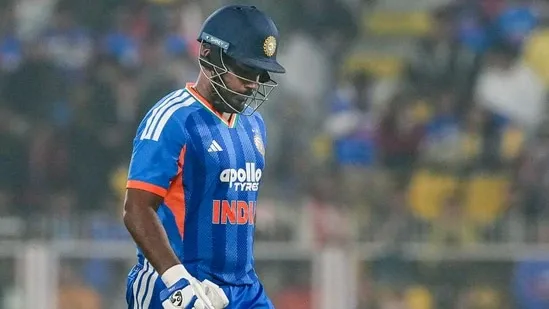
However, just when things seemed settled, clouds of inconsistency gathered once again. Samson endured three consecutive failures in the ongoing New Zealand series, managing just 16 runs in three innings, including a golden duck in Guwahati on Sunday. The slump has triggered renewed debate less than a fortnight before the T20 World Cup begins.
'I got abused': Jason Gillespie breaks silence on deleting ICC-Bangladesh tweet with India reference
On a night when India showcased their batting dominance by chasing 154 in just 10 overs to seal a 3-0 series sweep, Samson stood out for the wrong reasons. Facing the very first ball of the innings from Matt Henry, an angled length delivery, he attempted a flick off the crease, only for the ball to brush his back leg and crash into the stumps.
It was the second straight time Henry dismissed him in the series. In Raipur, Samson survived a dropped chance early but then opted for the aerial route against a length delivery, miscuing it to mid-on. In the series opener, Kyle Jamieson had removed him for just 10.
Former India opener and coach WV Raman summed up the concern succinctly after the Raipur dismissal. "Samson will be inconsistent as long as he doesn't adjust the speed of his bat on the downswing in relation to the pace of the ball," Raman wrote. "In simple terms, one can't drive a car at the same speed everywhere."
The dismissals once again highlighted Samson's vulnerability against high pace, an issue first exposed during the home series against England last year, where he fell to express bowling five times, including three consecutive dismissals to Jofra Archer.
That vulnerability also exposes a less-discussed gap in Samson's otherwise compelling narrative. Since his last century in 2024, he has crossed 30 only once as an opener, scoring just 104 runs in that period. The tally includes five single-digit scores and came at a strike rate of 133.3, inferior even to Gill's numbers during his unsuccessful run, which eventually led to his ouster.
That brings the inevitable question: could Samson face a similar fate again?
The pressure is not only form-driven. Ishan Kishan, who stormed into World Cup contention after a stunning Syed Mushtaq Ali Trophy campaign that aligned perfectly with the selectors' late strategic pivot, carried that momentum into international cricket with a blistering knock in Guwahati, one that even left Suryakumar Yadav visibly taken aback. Add to that Tilak Varma's expected return ahead of the fourth T20I following injury, and India are staring at a genuine selection headache.
Ishan featured in the first three matches only because Tilak Varma, India's first-choice No. 3, was unavailable. But with Sanju Samson's failures in Raipur and Guwahati, the idea of pushing Ishan up the order has gathered momentum, especially given the left-hander's ball-striking intent, which fits India's T20 template perfectly.
With Tilak set to return at No. 3, Vizag could see Samson warming the bench. But would that be a call too harsh, too soon?
What still works in Samson's favour is the context of his run. His struggles have come around a period of uncertainty, shifting between roles, adapting to the middle order, and being dropped midway through a series. With Suryakumar himself rediscovering form late in the build-up after going 24 T20Is without a fifty, India will hope Samson can script a similar turnaround.
But if the failures continue in Vizag and Thiruvananthapuram, the team management may be forced into a tough World Cup call.
Contact to : xlf550402@gmail.com
Copyright © boyuanhulian 2020 - 2023. All Right Reserved.