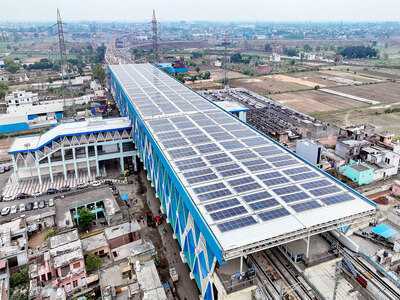
New Delhi [India], January 22 (ANI): India has made significant progress in expanding its power generation capacity over the last five years, with installed power capacity rising by nearly 36 per cent, largely driven by rapid growth in renewable energy, according to a report released by the Reserve Bank of India (RBI).
The report highlighted that 2025 marked a milestone year for India's clean energy transition, as the country recorded its highest-ever annual addition to renewable energy capacity.
This sharp rise was primarily led by a surge in solar power installations, reflecting strong policy support and growing private sector participation in the renewable energy space.
It stated that "Installed power capacity has increased by nearly 36 per cent over the past five years, largely driven by the expansion of renewable energy. In 2025, India recorded its highest-ever annual addition to renewable energy capacity, primarily led by a surge in solar installations".
Data from the Central Electricity Authority (CEA), cited in the report, shows that annual renewable energy capacity additions have steadily increased over the years. Renewable capacity addition rose from 5.6 gigawatt (GW) in 2020 to 14.4 GW in 2021 and further to 16.4 GW in 2022. Although additions moderated slightly to 13.0 GW in 2023, the pace picked up sharply thereafter, with 28.6 GW added in 2024 and a record 48.6 GW in 2025.
In contrast, additions to fossil fuel-based power capacity remained relatively modest during the same period, reflecting a gradual shift in India's energy mix. Fossil fuel capacity additions stayed low, ranging between around 1 GW to 4 GW annually, while nuclear capacity additions were marginal but stable.
Nuclear capacity saw small additions beginning 2023 onwards, indicating a renewed focus on diversifying clean energy sources beyond renewables.
The RBI report noted that India's clean energy push is aligned with its long-term climate and energy security goals. The expansion of renewable energy has played a key role in meeting rising electricity demand while reducing dependence on fossil fuels.
The report also highlighted recent policy initiatives aimed at strengthening India's nuclear energy sector. The introduction of the Sustainable Harnessing and Advancement of Nuclear Energy for Transforming India (SHANTI) Bill 22, 2025, along with the Nuclear Energy Mission, is expected to significantly boost nuclear power capacity.
Under these initiatives, India aims to raise its nuclear power capacity to 100 GW by 2047.
Overall, the RBI report highlighted that India's power sector is undergoing a structural transformation, with renewable energy emerging as the main driver of capacity growth.
The record additions in 2025 signal strong momentum in India's clean energy transition, positioning the country to meet its future energy needs in a sustainable manner. (ANI)
Contact to : xlf550402@gmail.com
Copyright © boyuanhulian 2020 - 2023. All Right Reserved.