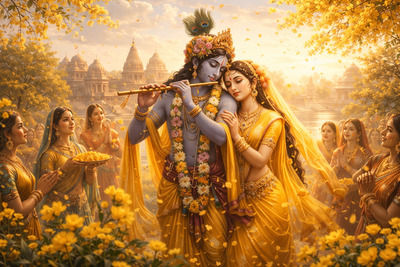
वसन्तो नाम जीवनस्य स्मरणम्।
यत्र हृदयं पुनः प्रेमं स्मरति॥
“Spring is not a season here. It is a remembrance.”
When Basant Panchami arrives in most parts of India, it announces itself with books placed before idols, children beginning their first lessons, and prayers offered to Goddess Saraswati for wisdom and clarity. Knowledge takes center stage. Learning is celebrated as divine.
But in Vrindavan, the same day unfolds very differently.
Here, Basant Panchami does not ask what you know. It asks what you still feel.
The lanes of Vrindavan do not wake up to the discipline of learning, but to the softness of spring. Yellow is not worn to honor intellect, but to welcome warmth back into the heart. The air carries a subtle shift, as if the land itself remembers something it had been holding back. In this sacred town shaped by Radha and Krishna, Basant Panchami is less a festival and more a permission.
Permission to feel longing again.
Permission to let love stir without needing fulfillment.
Permission to prepare the heart for devotion, not through study, but through remembrance.
This is why, in Vrindavan, Basant Panchami quietly steps away from Saraswati and turns toward love.
1. Basant Panchami Marks the Spiritual Arrival of Spring, Not Education  The veena represents harmony where sound emerges only after silence and balance are achieved.
In Vrindavan, Basant Panchami is understood first as the arrival of basant, the season of awakening. Spring is not merely climatic here. It is emotional and cosmic.
The trees, the river Yamuna, the birds, and the temples are believed to respond to the shift in season. Spring signals softness returning to the world after austerity. In the Vrindavan worldview, love requires softness to exist.
Thus, Basant Panchami becomes the day when the environment itself becomes capable of love again.
2. Saraswati Represents Knowledge, But Vrindavan Prioritizes BhavaSaraswati embodies clarity, discipline, and structured understanding. Her domain is articulation, grammar, and intellectual order.
Vrindavan’s spiritual culture does not reject Saraswati, but it does not centre her either. The dominant spiritual principle here is bhava, the inner emotional state of devotion.
In Vrindavan, one does not seek to understand God. One seeks to feel God.
A festival focused on wisdom naturally gives way to a festival focused on emotional readiness. That is why Saraswati worship remains secondary here on Basant Panchami.
3. Basant Panchami Begins the Love Cycle That Ends with Holi 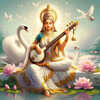 Saraswati and white
In Vrindavan, Basant Panchami is not an isolated event. It is the
first emotional step in a longer journey that culminates in Holi.
Basant Panchami signals the awakening of love. Holi celebrates its expression.
Between the two lies anticipation, longing, remembrance, and inner preparation. This is why Vrindavan treats Basant Panchami as the beginning of divine romance rather than a day of learning.
4. Radha’s Presence Shapes the Meaning of the Festival 
Radha is not worshipped in Vrindavan merely as Krishna’s companion. She is worshipped as the personification of love itself.
After Krishna’s departure from Vrindavan, Radha did not leave. Her presence transformed the land into a living memory of love in separation.
Basant Panchami is associated with Radha’s emotional world. It is believed to be the time when love, long restrained, is allowed to stir again. Saraswati’s intellectual energy does not align with this emotional landscape as deeply as Radha’s does.
5. Kamadeva’s Symbolism Is Central to Basant Panchami in VrindavanIn broader Hindu mythology, Basant Panchami is also associated with
Kamadeva, the deity of desire.
Vrindavan does not interpret Kamadeva as physical temptation. Here, desire is transformed into divine longing. Kamadeva’s reappearance in spring is seen as the return of
the ability to feel longing, which is essential for devotion.
This subtle association further distances the festival from Saraswati’s realm of intellect.
6. Yellow Is the Color of Love in Vrindavan, Not Just KnowledgeYellow is traditionally linked to Saraswati, symbolizing clarity and learning. But in Vrindavan, yellow takes on a different meaning.
It represents mustard flowers blooming in nearby fields, Krishna’s attire, and the warmth of renewed emotion. Yellow becomes the color of gentle love, not sharp intellect.
Thus, even shared symbols are interpreted through the lens of devotion rather than education.
7. Vrindavan Sees Love as the Highest Wisdom 
In Vrindavan’s spiritual hierarchy, love surpasses knowledge. The idea is simple yet profound. Knowledge can lead to ego. Love dissolves it.
That is why festivals here prioritize emotional surrender over intellectual discipline. Basant Panchami aligns naturally with this worldview when understood as a day of emotional awakening.
Contact to : xlf550402@gmail.com
Copyright © boyuanhulian 2020 - 2023. All Right Reserved.