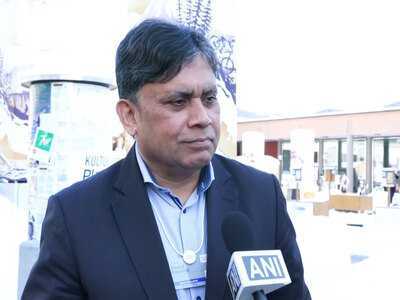
Davos [Switzerland], January 19 (ANI): Bharat Kaushal, Executive Chairman of Hitachi India, at the World Economic Forum in Davos, Switzerland, highlighted how technology is essential for tackling global disruptions and shaping the future of infrastructure and manufacturing.
Speaking to ANI, he noted that Hitachi, with a 90-year history in India, plays a key role in the country's twin push for both physical and digital infrastructure development
Bharat Kaushal said, "I think Davos's relevance has come to the central stage once again only because there is too much disruption in the world. A lot of it, by technology or thanks to technology, is also progressive. At the same time, there is a lot of uncertainty as well."
He emphasised that the "sea change" in India over the last 15 years regarding implementation and quality consciousness has transformed the country into a hub for globally competitive solutions.
The integration of Artificial Intelligence (AI) and robotics is central to Hitachi's evolving business model, particularly as these technologies become "horizontals" affecting every sector of the economy.
Kaushal highlighted that AI is no longer a distant prospect but a reality that is fundamentally changing how outcomes are targeted through supply chains and partnerships. Kaushal said, "If I'm looking at energy as a service, if I'm looking at mobility as a service, then I will have to have some kind of a real imagination of where I'm throwing the ball. I may be 40 % of an outcome, and maybe I should target that in the future with investments or with supply chain and partnerships, I should become 60 % of an outcome."
Hitachi's impact is notably visible in the energy and rail sectors, which Kaushal described as "social and political priorities" for India. Hitachi's technological footprint in India includes powering 9 out of 10 metro cars and managing 7 of the 14 high-voltage direct current lines.
"The energy sector has come to acquire a much larger meaning in everyday life. It was a power sector vertical. It's now become an energy horizontal, which is almost touching all areas, not just industry, but inclusion, sustainability, storage, renewable energy," said Kaushal.
The modernisation of the Indian Railway remains a flagship focus, with AI playing a direct role in condition monitoring and predictive maintenance. Kaushal noted that the government's massive investment--approximately USD 50 billion in rail and USD 40 billion in energy--presents a significant opportunity to deploy agentic AI to prevent losses and optimise maintenance, potentially saving 25% in costs.
Kaushal stated, "What agentic does is that you don't have to do in every car at the same time to know it. All the learnings that you're making in the cars that you're touching are very good prediction points for the other cars that are under operation."
Looking ahead, the Hitachi board remains deeply committed to the Indian market, having held its significant annual meeting in New Delhi recently. Kaushal indicated that by April, following the approval of new budgets, the company would be in a position to detail its specific roadmap for 2030 and 2035.
Currently, the Indian business generates several billion dollars in revenue, with a substantial portion of India-based work supporting international markets. (ANI)
Contact to : xlf550402@gmail.com
Copyright © boyuanhulian 2020 - 2023. All Right Reserved.