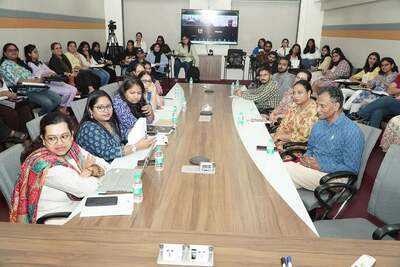
Hyderabad Sind National Collegiate University (HSNC University), a State Public University, in collaboration with the Department of Sociology, University of Mumbai successfully organised a two-day national workshop titled “Doing Academic Writing Differently”. The workshop was sponsored by the Indian Sociological Society (ISS) and brought together nearly 60 research scholars, teachers and early-career academics from across institutions.
The workshop opened with opening remarks by Dr. Manisha Rao, Head, Department of Sociology, University of Mumbai, who described academic writing as a complex yet deeply rewarding process. She highlighted the importance of acknowledging power relations, engaging with multiple voices and embracing the non-linear nature of research writing. Dr. Leena Pujari, Dean, Inter-disciplinary Studies, HSNC University followed with reflections on the anxieties researchers face while translating ideas into text, noting the emergence of experimental and alternative genres of academic writing.
Addressing the participants, Prof. Maitrayee Chaudhuri, President, Indian Sociological Society, emphasised the centrality of sustained reading as the foundation of good writing and reminded scholars of the importance of institutional protocols in academic publishing. Prof. Vivek, Treasurer, ISS and Guest of Honour, offered a practice-oriented perspective, stressing clarity, structure, style and accessibility. Through evocative metaphors drawn from everyday life, he argued for research writing that is engaging, grounded and intelligible to wider audiences.
The keynote address on Day 1 was delivered by Dr. Indra Munshi on “Academic Writing: A Sociological Journey”. She described academic writing as both science and art, underscoring the importance of rewriting, reflexivity and disciplinary rigour. Drawing on extensive experience, she guided participants through the formulation of research problems, structuring arguments, conducting ethnographic and archival research and maintaining analytical continuity. Her emphasis on journaling, ethical fieldwork and balancing empathy with critical distance resonated strongly with young researchers.
Subsequent sessions on Day 1 included Dr. Anagha Tambe’s lecture on “Selecting Literature: Reading the Absences”, which foregrounded the politics of literature review and citation, urging participants to interrogate silences, assumptions and hierarchies of knowledge. Dr. Sharmila Sreekumar’s session, “Staying with the Problem”, focused on re-framing and re-formulating research questions, encouraging imaginative inquiry, conceptual risk-taking and non-linear research processes. The day concluded with Dr. Gita Chadha’s session on “Self and the Politics of Knowledge Production”, which explored feminist methodologies, standpoint epistemology and auto-ethnography as rigorous modes of social science inquiry.
Day 2 opened with Dr. Ritupurna Patgiri’s session on “Reading and Writing in the Digital Age”, which critically examined the implications of digital technologies, AI, predatory journals and open-access publishing. She urged scholars to cultivate authenticity, reflexivity and ethical awareness in an increasingly standardised academic environment, while also recognising blogs and public writing as emerging scholarly spaces.
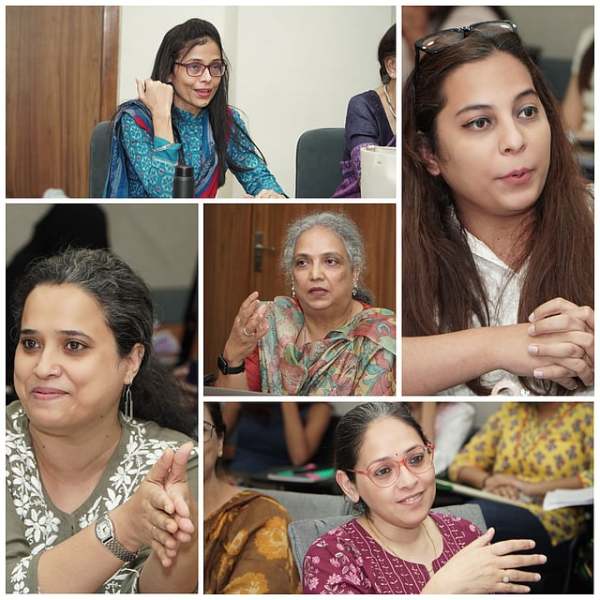
Dr. Meena Gopal’s session on “Writing Embodied Labour” drew from feminist research and activism, discussing bar dancers’ struggles, women workers’ labour and women athletes’ experiences. She highlighted reflexivity, ethical accountability and writing as a collective, relational practice rooted in social transformation.
The workshop further engaged with Global South perspectives through Dr. Vaishali Diwakar’s session on “Reframing Academic Writing in the Global South”, which emphasised intellectual ownership, collaborative research with communities, visual sociology and locally grounded theory-building. The final session by Dr. P. Bindulakshmi, “Citing from the Margins”, examined citation as an ethical and political practice, urging inclusive referencing that recognises marginalised scholars as theory-producers rather than merely empirical sources.
Overall, the workshop offered a rich, interdisciplinary and critical engagement with academic writing as a political, ethical and creative practice. Participants widely appreciated the space to rethink conventional modes of research writing and to imagine more inclusive, reflexive and socially grounded approaches to knowledge production.
Contact to : xlf550402@gmail.com
Copyright © boyuanhulian 2020 - 2023. All Right Reserved.