Govt may levy duty to mop up windfall gains of fuel retailers
NEW DELHI: A sustained low in international oil prices has led to a surge in profits for state-run fuel retailers, prompting the government to consider mopping up these windfall gains through a levy to build a cushion in the event of a future spike in crude prices-a scenario many see as plausible given global geopolitical uncertainty.
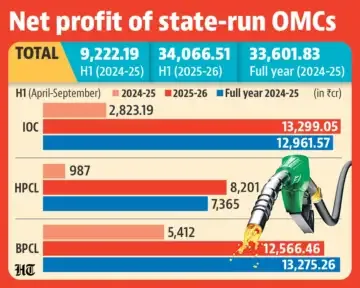
The three state-run oil marketing companies (OMCs) - Indian Oil Corporation (IOC), Bharat Petroleum Corporation Ltd (BPCL) and Hindustan Petroleum Corporation Ltd (HPCL) - which enjoy a near monopoly in India's fuel retail business, posted a combined net profit of ₹34,066.51 crore in the first half of 2025-26, a 269.4% year-on-year jump that exceeded their full-year profit of ₹33,601.83 crore in 2024-25, according to publicly available data.
 Refiners are currently earning gains of approximately ₹12 per litre on petrol and ₹10 per litre on diesel after international crude oil prices slumped, especially since it fell under $70 a barrel in August, according to analysts.
People aware of the development said the government's first option could be to levy a special additional excise duty (SAED) to mop up about 50% of the windfall gains without any change in retail prices of auto fuels. This would allow the government to build fiscal headroom while keeping pump prices unchanged for consumers.
On April 8, 2025, the government raised SAED on petrol and diesel by ₹2 per litre each in similar manner to garner about ₹34,000 crore in a year. This excise duty hike took place after the Centre had slashed excise duty to reduce pump prices of the fuels by ₹13 per litre and ₹16 a litre on petrol and diesel, respectively in two tranches in November 2021 and May 2022.
But other options are not off the table, including passing on the windfalls equitably to all three stakeholders - the government, the refiner and the consumer-or allowing OMCs to enjoy the windfalls until the end of this fiscal year on March 31, 2026, and then taking the dividend.
The government will follow a calibrated approach based on geopolitical developments and volatility in international oil prices, the people said, requesting anonymity.
IOC, India's biggest refiner, saw its net profit jump over 371% to ₹13,299 crore in the first half of 2025-26, compared with ₹2,823.19 crore in the same period last year. Its half-yearly profit exceeded the ₹12,961.57 crore it earned in the full financial year of 2024-25. HPCL's net profit surged 731% on an annualised basis to ₹8,201 crore, while BPCL posted over 132% growth at ₹12,566.46 crore.
"Marketing margins for OMCs have remained robust during the current fiscal year, sustaining healthy levels over the past nine months. In the first eight months of fiscal 2026, OMCs' net realisations exceeded international product prices by an average of approximately ₹11 per litre for petrol and ₹7 per litre for diesel," said Prashant Vasisht, senior vice president and co-group head, corporate ratings, ICRA Ltd.
Vasisht, however, declined to comment on whether OMCs would slash pump prices of petrol and diesel, or the government would raise excise duty.
While OMCs are technically free to fix pump prices of petrol and diesel daily, the government tacitly controls pricing of these sensitive fuels, the people cited above said. The current volatile geopolitical situation, with the US facing tensions with two key oil-producing countries-Venezuela and Iran-has added to the complexity of any pricing decision.
IOC, BPCL, HPCL, and the ministries of petroleum and finance did not respond to an email query on this matter.
The US Energy Information Administration (EIA) on January 13 forecasted a fall in oil prices to $56 a barrel in 2026 that will continue into 2027. "We expect oil prices will decline in 2026, as global oil production exceeds global oil demand… We forecast the Brent crude oil price will average $56 per barrel (b) in 2026, 19% less than in 2025, then average $54/b in 2027," EIA said in its short-term energy outlook (STEO).
A recent research report by the State Bank of India (SBI) also projected that crude oil prices would "soften significantly in 2026" to touch $50 per barrel by June 2026.
Hindustan Times reported on January 7 that India's average crude oil import cost of the Indian basket fell below $60 a barrel on January 5, 2026, a near five-year low. Although it bounced back to over $60 due to geopolitical tensions in Venezuela and Iran, the average price of the Indian basket in the current month (up to January 16) remained soft at $61.37 a barrel, a 58-month low.
Similarly, India's average benchmark petrol price in the current month (up to January 16) stood at $71.18 per barrel, the lowest since February 2021. For diesel, it is currently $75.84, the lowest since August 2021.
OMCs have frozen retail rates since March 15, 2024. Petrol is priced at ₹94.77 a litre in Delhi and diesel at ₹87.67, unchanged since then except for a marginal five-paise increase on October 30, 2024, on account of marketing cost adjustments.
Contact to : xlf550402@gmail.com
Copyright © boyuanhulian 2020 - 2023. All Right Reserved.