MP: Dr. Mohan Yadav, the chief minister of Madhya Pradesh, presided over a cabinet meeting in Bhopal on Tuesday, during which the council of ministers approved a number of important measures pertaining to the promotion of space technology, agriculture, education, and renewable energy.
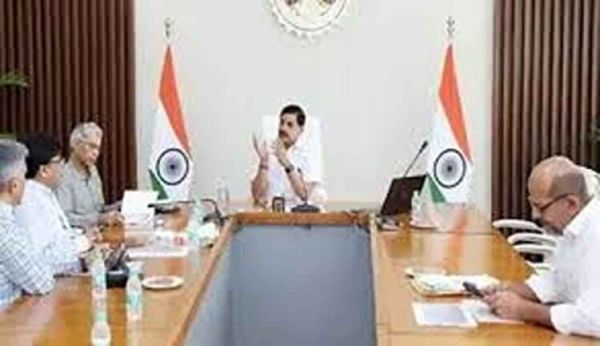
The ‘Madhya Pradesh Space Tech Policy 2026’ and the Madhya Pradesh Space Act 2026’s ratification was a significant highlight.
This historic strategy seeks to promote innovation in downstream applications, satellite manufacturing, and geospatial analysis. Over the next five years, it is expected to bring in Rs 1,000 crore in investments and create over 8,000 employment, making the state a major participant in India’s expanding space industry.
To guarantee constant power supply, the cabinet approved large-scale solar-to-storage projects in the field of renewable energy. These include a 200 MW solar-based project that can store energy for 24 hours, a 300 MW solar-to-storage project that can store energy for four hours, and a 300 MW storage project that can store energy for six hours.
Similar to earlier models that achieved prices as low as Rs 2.25 per unit, expressions of interest will be requested, and projects will be granted to the lowest tariff bidder. This action supports national initiatives to effectively store solar energy, such as using batteries or solar pumps for pumped storage, allowing for peak-hour supply even at night.
Approvals for irrigation greatly boosted agriculture.
In order to irrigate 1,140 hectares over 26 villages in Khilchipur tehsil and assist 10465 households, the Mohanpura Expansion Irrigation Project in Rajgarh district’s Sarangpur tehsil obtained Rs 396.21 crore.
In the Raisen district, the Bana Uhan Irrigation Project was authorized for Rs 386.22 crore to benefit 15,000 hectares in 36 villages and 6800 farmer households, while the Sultanpur Lift Irrigation Project received Rs 115.99 crore to cover 5,700 hectares in 20 villages for 3,100 farmers.
When taken as a whole, these three initiatives will directly assist more than 20,000 farmers in increasing production. The second phase of the Sandipani School Scheme, which approved 200 fully equipped schools at an anticipated cost of Rs 3,660 crore (about Rs 17–18 crore per school), was a significant decision for education. This expands on the 75 schools from the first phase.
Additionally, a four-tier time-bound pay scale plan of Rs 322 crore was approved for teachers in the educational cadre, including recruits and assistant instructors, providing much-needed financial assistance.
Additional approvals included a massive Rs 11,337 crore water augmentation scheme for the Ujjain division, which is expected to be finished by 2028; a 50% motor vehicle tax exemption for sales at the Gwalior Trade Fair 2026 and the Ujjain Vikram Mahotsav Trade Fair 2026; and Rs 1 crore ex-gratia compensation (beyond the initial Rs 1 lakh) for the family of the late Assistant Sub-Inspector Ramcharan Gautam, who died while on duty.
To decide on the excise policy, a ministerial committee was also established. These choices demonstrate the government’s commitment to sustainable development, innovation, education, and farmer welfare—all of which have been designated as the 2026 emphasis.
Contact to : xlf550402@gmail.com
Copyright © boyuanhulian 2020 - 2023. All Right Reserved.