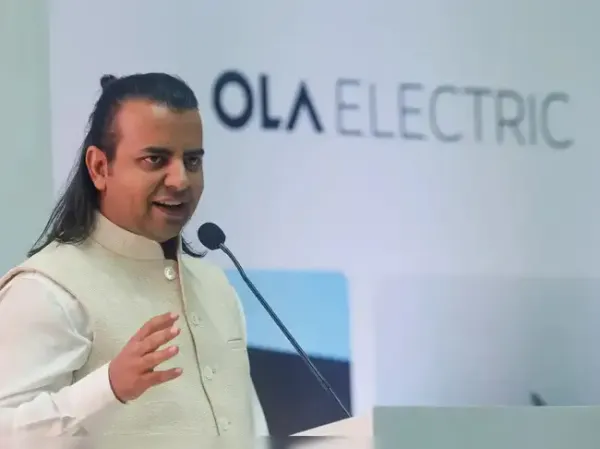
Ola Electric has launched its residential battery energy storage system, Shakti, from its battery gigafactory in Krishnagiri, Tamil Nadu, marking the electric two-wheeler maker’s entry into the non-automotive energy storage segment, the company informed stock exchanges on Monday.
The product, announced earlier by founder Bhavish Aggarwal, is powered by Ola Electric’s indigenously developed 4680 Bharat Cell and is positioned as a residential and small commercial energy storage solution.
The launch signals a diversification push as the company looks to expand beyond its core automotive business amid intensifying competition in India’s electric vehicle market.
“With Ola Shakti, we have reimagined how India will store and consume energy. Powered by our indigenous 4680 Bharat Cell, Ola Shakti makes reliable, affordable, and intelligent energy storage accessible to every Indian home, farm, and business,” said an Ola Electric spokesperson.
According to the company, Shakti will be offered in four configurations, with storage capacities ranging from 1.5 kilowatt-hours (kWh) to 9.1 kWh and power output between 1 kilowatt (kW) and 6 kW.
It said the system can support household appliances such as refrigerators, air conditioners and induction cookers, as well as agricultural and small business equipment like farm pumps, with charging times of up to two hours.
Ola Electric had earlier announced introductory prices of Rs 29,999, Rs 55,999, Rs 1,19,999 and Rs 1,59,999 for the four configurations, applicable to the first 10,000 units.
The company has invested heavily in battery cell manufacturing and related infrastructure over the past few years, even as it faces scrutiny over profitability timelines. The diversification into energy storage could offer a longer-term revenue stream for the company.
Operationally, Ola Electric has ceded ground to rivals in its core automotive business over the past year. According to Vahan data, the company’s market share fell to 16.1% in 2025 from 36.7% a year earlier, as competitors such as TVS Motor Company, Bajaj Auto, Ather Energy and Hero MotoCorp gained traction.
Several large investors have either exited or pared their stakes amid mounting challenges. Recently, SoftBank Group reduced its stake in Ola Electric to 13.53% from 15.68%. Earlier, Z47, formerly Matrix Partners India, fully exited its investment in the company.
Ola Electric’s shares hit an all-time low of Rs 30.79 on December 18, 2025. The company is currently valued at about Rs 17,378 crore, sharply lower than its valuation of more than Rs 33,000 crore at the time of its public listing on August 9, 2024.
For the second quarter of this financial year, Ola Electric’s operating revenue fell 43% to Rs 690 crore, while its net loss narrowed to Rs 418 crore.
The product, announced earlier by founder Bhavish Aggarwal, is powered by Ola Electric’s indigenously developed 4680 Bharat Cell and is positioned as a residential and small commercial energy storage solution.
The launch signals a diversification push as the company looks to expand beyond its core automotive business amid intensifying competition in India’s electric vehicle market.
“With Ola Shakti, we have reimagined how India will store and consume energy. Powered by our indigenous 4680 Bharat Cell, Ola Shakti makes reliable, affordable, and intelligent energy storage accessible to every Indian home, farm, and business,” said an Ola Electric spokesperson.
According to the company, Shakti will be offered in four configurations, with storage capacities ranging from 1.5 kilowatt-hours (kWh) to 9.1 kWh and power output between 1 kilowatt (kW) and 6 kW.
It said the system can support household appliances such as refrigerators, air conditioners and induction cookers, as well as agricultural and small business equipment like farm pumps, with charging times of up to two hours.
Ola Electric had earlier announced introductory prices of Rs 29,999, Rs 55,999, Rs 1,19,999 and Rs 1,59,999 for the four configurations, applicable to the first 10,000 units.
The company has invested heavily in battery cell manufacturing and related infrastructure over the past few years, even as it faces scrutiny over profitability timelines. The diversification into energy storage could offer a longer-term revenue stream for the company.
Operationally, Ola Electric has ceded ground to rivals in its core automotive business over the past year. According to Vahan data, the company’s market share fell to 16.1% in 2025 from 36.7% a year earlier, as competitors such as TVS Motor Company, Bajaj Auto, Ather Energy and Hero MotoCorp gained traction.
Several large investors have either exited or pared their stakes amid mounting challenges. Recently, SoftBank Group reduced its stake in Ola Electric to 13.53% from 15.68%. Earlier, Z47, formerly Matrix Partners India, fully exited its investment in the company.
Ola Electric’s shares hit an all-time low of Rs 30.79 on December 18, 2025. The company is currently valued at about Rs 17,378 crore, sharply lower than its valuation of more than Rs 33,000 crore at the time of its public listing on August 9, 2024.
For the second quarter of this financial year, Ola Electric’s operating revenue fell 43% to Rs 690 crore, while its net loss narrowed to Rs 418 crore.