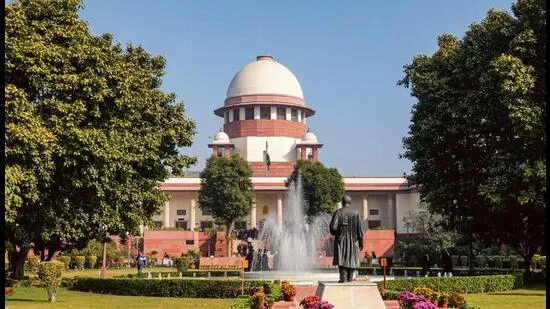
Telangana withdraws plea against Polavaram project; SC leaves door ope
The Supreme Court on Monday termed as "prima facie not maintainable" the writ petition filed by the Telangana government seeking to restrain Andhra Pradesh and its agencies from proceeding with preparatory and project-related activities for the Polavaram-Banakacherla/Nallamalasagar Link P
A bench comprising Chief Justice of India Surya Kant and Justice Joymalya Bagchi disposed of the petition while granting liberty to Telangana to avail of any other appropriate remedies available in law, including the institution of a suit, and to raise all contentions urged in the present proceedings.
"The writ petition is disposed of as being prima facie not maintainable, with liberty to the petitioner state to avail of appropriate remedy in accordance with law and raise all contentions taken in the instant petition," the bench said in its order.
The order followed an exchange in court in which senior advocate Abhishek Manu Singhvi, appearing for the Telangana government, sought to justify the invocation of Article 32 of the Constitution. Singhvi submitted that Telangana had filed the writ petition in view of what it described as clear violations of a binding tribunal award governing the allocation of Godavari river waters.
"There is an award fixing the allocated quantum of the Godavari waters, and any diversion beyond the award is an illegality. Further, there is a blatant violation of various provisions of law," he told the court, referring to Andhra Pradesh's proposed diversion of water under the PBLP/PNLP.
The bench was unconvinced, pointing out that Telangana was relying on a possible violation of the tribunal award, a matter that could be comprehensively examined in a suit. "You are also relying on the fact that there is a possible violation of the award. Therefore, the issues can be determined in a suit," the bench observed.
The court underscored that the dispute could not be confined to Telangana and Andhra Pradesh. "The parties to the award are not only Telangana and Andhra Pradesh, which are parties in the present petition. There are other states as well, including Karnataka and Maharashtra. However, in your writ petition, other states are not parties."
When Singhvi argued that a civil suit would entail greater limitations, the bench disagreed, emphasising that such proceedings would allow for a fuller and more inclusive adjudication. "In a suit, it will be a more wholesome determination of issues, with all parties likely to be affected as parties and getting the chance to be heard," the court said.
At this stage, Singhvi sought to withdraw the petition without prejudice. "The court may record my submissions that we are withdrawing this petition without any prejudice to our rights," he said, following which the court formally disposed of the matter.
Senior counsel Mukul Rohatgi appeared for the Andhra Pradesh government.
During the previous hearing on January 5, the same bench raised serious doubts over the maintainability of the petition, indicating that a suit under Article 131 of the Constitution, which confers original jurisdiction on the Supreme Court to adjudicate disputes between states, would be a "more comprehensive and effective" remedy.
During that hearing, the bench had observed that the core of the controversy lay in competing inter-state claims over Godavari river waters and the potential impact of Andhra Pradesh's proposed project on Telangana's share as determined by existing tribunal awards.
The controversy centres on Andhra Pradesh's proposal to transfer surplus water from the Godavari river at the Polavaram reservoir to the drought-prone Banakacherla region in Rayalaseema. The project is projected as a major intervention to improve irrigation, drinking water supply, and groundwater recharge in water-stressed areas.
Telangana has consistently opposed the proposal, contending that it threatens its lawful share of Godavari waters and violates the existing award of the Godavari Water Disputes Tribunal. According to the state, the award, which governs allocations among multiple basin states, remains frozen, and any unilateral diversion by Andhra Pradesh would amount to an illegality.
In its writ petition, Telangana alleged that the project envisages diverting up to 200 TMC (thousand million cubic feet) of water, far exceeding the originally sanctioned 80 TMC for transfers to the Krishna basin. It claimed that Andhra Pradesh was proceeding without the consent of the co-basin states and in violation of the Inter-State Water Disputes Act.
Telangana has accused Andhra Pradesh of bypassing statutory and regulatory processes by advancing project planning, tenders, and preparatory activities without in-principle approval from the Central Water Commission and requisite clearances from the Union ministry of jal shakti. Additionally, the state has argued that the project runs contrary to the Andhra Pradesh State Reorganisation Act, 2014, which mandates cooperative federalism and equitable utilisation of shared water resources following the bifurcation of the erstwhile state.
The dispute has spilled into the political arena, with leaders trading allegations over the handling of the project. BRS leader T Harish Rao has accused Andhra Pradesh of securing approvals through political manoeuvring amid alleged inaction by the Telangana government.
Telangana irrigation minister N Uttam Kumar Reddy has maintained that the government has robustly defended the state's irrigation interests, reiterating that the proposed project violates both the tribunal award and the 2014 Reorganisation Act. Andhra Pradesh has consistently defended the project as essential for regional development and water security, particularly in drought-hit Rayalaseema.
Contact to : xlf550402@gmail.com
Copyright © boyuanhulian 2020 - 2023. All Right Reserved.