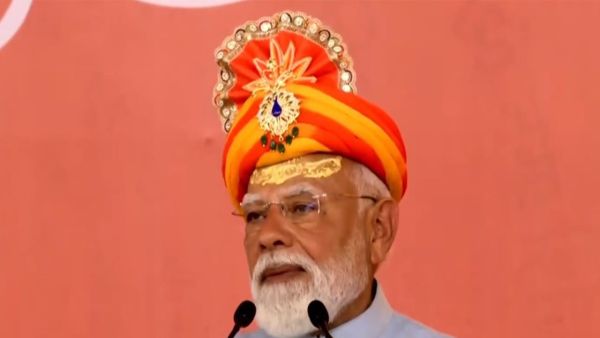
PM Modi, at the Somnath temple, said its flag, a thousand years after Mahmud of Ghazni's attack, symbolises India's resilience. He paid tribute to ancestors who defended their faith and highlighted the temple's enduring legacy and power.
Somnath's Flag a Testament to India's Resilience
Prime Minister Narendra Modi, while recalling the 1,000-year-old attack on the Somnath temple by Mahmud of Ghazni, emphasised that even though the invaders might have thought they had triumphed, even today, a thousand years later, the flag flying atop the Somnath Mahadev Temple stands as a testament to India's strength, power, and resilience.

Addressing a gathering after the Shaurya Yatra concluded here, PM Modi paid tribute to the ancestors of those present, saying they, like generations before, risked their lives for their faith, their beliefs, and for Lord Mahadev. "As I speak to you today, the question keeps arising in my mind: exactly one thousand years ago, at this very place where you are sitting, what would the atmosphere have been like? The ancestors of those present here, your ancestors, our ancestors--risked their lives for their faith, for their beliefs, for Lord Mahadev. A thousand years ago, the attackers might have thought they had won, but even today, a thousand years later, the flag flying atop the Somnath Mahadev Temple proclaims to the entire universe the strength of India, its power, and its resilience," PM Modi said.
Grandeur of the Somnath Swabhimaan Festival
PM Modi also highlighted the grandeur of the ongoing festivities. He shared his experience from yesterday evening, which featured a remarkable display of 1,000 students from Vedic Gurukuls, presented through 1,000 drones, showcasing Somnath's thousand-year-old legacy. "For 72 continuous hours, there has been uninterrupted chanting of Omkar, 72 continuous hours of mantra recitation, and I saw yesterday evening the presence of a thousand students from Vedic Gurukuls showcased through 1,000 drones, the depiction of Somnath's thousand-year-old legacy, and today, a heroic procession to the temple with 108 horses. The marvellous presentation of mantras and devotional songs is utterly enchanting," PM Modi said.
Describing the moment, he emphasised that the occasion was extraordinary, and that the presence of Lord Mahadev, the vast ocean waves, the sun's rays, the echoing mantras, and the devotion of thousands of attendees had made the celebration truly divine. "This moment is extraordinary, this atmosphere is extraordinary, this celebration is extraordinary. On one hand, Lord Mahadev himself, and on the other, the vast waves of the ocean, the rays of the sun, the echo of the mantras, the surge of devotion--and in this divine environment, the presence of all of you, devotees of Somnath, is making this occasion truly divine. I consider it a great fortune that, as the President of the Somnath Temple Trust, I have the opportunity to actively serve in the Somnath Swabhimaan Festival," he said.
A History of Destruction and Revival
The attack on the Somnath temple marked the beginning of a long period during which the temple was repeatedly destroyed and rebuilt over centuries. Despite this, Somnath never ceased to exist in the collective consciousness of the people. The cycle of the temple's devastation and revival is unparalleled in world history. It demonstrated that Somnath was never merely a stone structure, but a living embodiment of belief, identity, and civilisational pride.
On Kartak Sud 1, Diwali day, November 12, 1947, Sardar Vallabhbhai Patel visited the ruins of Somnath and expressed his resolve to rebuild the temple, viewing its restoration as essential to reviving India's cultural confidence. The reconstruction, carried out with public participation, culminated in the consecration of the present temple on May 11, 1951, in the presence of then-President Rajendra Prasad.
In 2026, the nation marks 75 years since the historic 1951 ceremony, reaffirming India's civilisational self-respect.
Revered as the first among the 12 Aadi Jyotirlingas of Lord Shiva, the Somnath Temple complex stands majestically along the Arabian Sea, crowned by a 150-foot shikhar, symbolising enduring faith and national resolve. (ANI)
(Except for the headline, this story has not been edited by Asianet Newsable English staff and is published from a syndicated feed.)Contact to : xlf550402@gmail.com
Copyright © boyuanhulian 2020 - 2023. All Right Reserved.