New Delhi: For years, road safety conversations in India have focused on better highways, stricter fines, and safer cars. Now, the government is preparing to add something new to that mix. By the end of 2026, vehicles on Indian roads may start talking to each other directly.
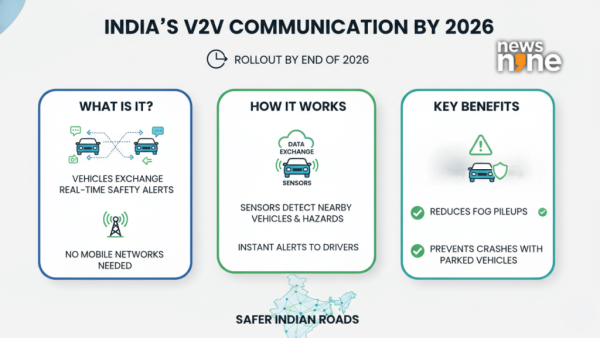
The Government of India is planning a nationwide rollout of Vehicle-to-Vehicle communication, or V2V. The goal is simple on paper. Fewer crashes, fewer pileups in fog, and fewer tragic accidents involving parked vehicles and fast-moving traffic.
What the government is planning for Indian roads
The push for V2V technology was discussed at the Annual Meeting with State Road Transport Ministers. Union Road Transport and Highways Minister Nitin Gadkari said the system is expected to help prevent accidents, especially where parked vehicles are hit from behind and during heavy fog conditions.
The idea is to let vehicles exchange signals directly, without depending on mobile networks. When another vehicle comes dangerously close, drivers get real-time alerts. According to officials, this could reduce large-scale pileups that often happen during winter fog on highways in north India.
The project cost is estimated at around Rs 5,000 crore. The technology will first be notified by end of 2026, followed by phased implementation. Initially, it will be installed only in new vehicles.
India plans V2V safety tech by 2026
What exactly is V2V technology
Vehicle-to-Vehicle communication allows cars, buses, trucks, and even two-wheelers to talk to each other. Each vehicle shares basic data such as speed, location, direction, braking, and turning intent.
Think of it as a peer-to-peer safety network on wheels. There is no central tower. Every vehicle acts as both a sender and receiver. In crowded areas, this creates a mesh where warnings can travel beyond what the driver can see.
Officials say the system will work from all sides of the vehicle, offering 360-degree alerts. It will warn about nearby moving vehicles and also stationary or roadside vehicles.
Why V2V matters more than sensors alone
Most modern cars already use cameras, radar, and sensors. These work well, but they have limits. A camera struggles around sharp bends or in thick fog. A sensor may miss a broken-down vehicle hidden behind a curve.
V2V does not rely on line of sight. If a car brakes suddenly ahead, the warning can travel through multiple vehicles within seconds. This is especially useful on highways where speeds are high and reaction time is short.
Over time, V2V is expected to work alongside Advanced Driver Assistance Systems (ADAS). Some premium SUVs already offer similar features, but those rely mainly on onboard sensors. After the official rollout, such vehicles will be aligned with the new system.
How alerts will reach drivers
The system is expected to use a device similar to a SIM card installed in vehicles. Once active, it sends and receives safety signals automatically.
Drivers can expect alerts for:
- Vehicles approaching too fast from behind
- Unsafe distance from the vehicle ahead
- Parked or stalled vehicles nearby
- Poor visibility situations like dense fog
Early versions will likely only warn drivers using sounds or dashboard messages. In later stages, the system could link with automatic braking and steering assistance.
Bigger road safety push beyond V2V
The transport ministry is also tightening other safety rules. Officials flagged poor bus design as a major cause of fatal accidents. Existing buses will be fitted with fire extinguishers, driver drowsiness detection systems, and emergency hammers for passengers.
Ministry officials say V2V technology is currently used in only a few countries, making India one of the larger markets to attempt a nationwide rollout.
For everyday drivers, this shift may feel invisible at first. No flashy screens. No extra buttons. But if vehicles can warn each other before danger strikes, Indian roads could quietly become safer.
Contact to : xlf550402@gmail.com
Copyright © boyuanhulian 2020 - 2023. All Right Reserved.