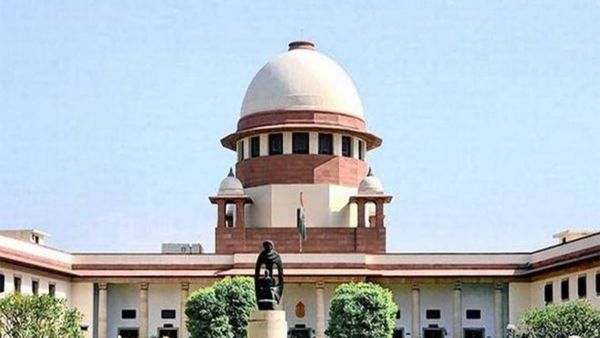
The Supreme Court questions if a Rajya Sabha Chairman's absence can render a judge's removal process 'unworkable', during a hearing on Justice Yashwant Varma's plea against an Inquiry Committee formed by the Lok Sabha Speaker.
The Supreme Court on Thursday asked whether the absence of the Rajya Sabha Chairman to decide on the admission of a removal motion, particularly in cases of urgency owing to a judge's alleged incapacity under the Judges (Inquiry) Act, would render the entire removal process "unworkable".

The query arose during an exchange between the Bench and counsel appearing for Allahabad High Court judge, Justice Yashwant Varma, on the scope of the Deputy Chairman's powers to act as Chairman and decide on the admission (or rejection) of a removal motion in the latter's absence.
The Court was hearing Justice Varma's plea challenging the Inquiry Committee constituted by the Lok Sabha Speaker to probe corruption allegations against him, following the admission of a removal motion in the Lok Sabha.
After a three-day hearing, a Bench of Justices Dipankar Datta and Satish Chandra Sharma reserved its decision on Justice Varma's challenge to the validity of the Inquiry Committee formed by the Speaker of the Lok Sabha to probe corruption charges against him.
Justice Varma's Contentions
Justice Varma has contended that when removal motions are moved in both Houses of Parliament on the same day, the formation of a Joint Committee requires admission of the motion by both Houses. In the present case, he argues that the Deputy Chairman of the Rajya Sabha's rejection of the motion renders the Committee unsustainable under the Judges (Inquiry) Act, which prescribes the procedure for the removal of judges.
Senior Advocates Mukul Rohatgi and Siddharth Luthra, appearing for Justice Varma, argued that, in the absence of the Rajya Sabha Chairman, the Lok Sabha could not unilaterally constitute an Inquiry Committee when the removal motion was moved in both Houses on the same day. Rohatgi submitted that where a vacancy exists in the office of the Rajya Sabha Chairman, the motion cannot be sustained until a new Chairman assumes office.
While the Deputy Chairman may exercise certain functions of the Chairman in the Chairman's absence, Rohatgi argued that the Deputy Chairman lacks the authority to admit or reject a motion for removal under the Judges (Inquiry) Act, which provides procedural safeguards to a judge at every stage.
The Bench asked who would act in the event of an immediate matter if the Chairman is absent. Rohatgi responded that such action could be taken only after the Chairman's position is filled, "even if it takes four to six months." Rohatgi further contended that the Deputy Chairman's action was ultra vires and that the motion must go back to the Chairman. He clarified that the Deputy Chairman was ultra vires in acting as Chairman, not merely in rejecting the motion.
He submitted that if the motion were admitted, a Joint Committee would automatically come into existence, but that admission must involve concurrence by both Houses. The Bench enquired that if the Chairman were to admit the motion and agree, the constitution of the Committee by the Speaker would not suffer from any illegality. Rohatgi responded that the Chairman must admit the motion after due consideration and discussion, and that, since the Chairman is now in office, the process may be resumed.
Adding on the arguments of his co-counsels, senior advocate Jayant Mehta, also representing Justice Varma, added that the embodiment of power does not lie in Parliament collectively, but in a single individual deciding on the admission of the motion, in such cases. "Embodiment of power is not in Parliament Single, solitary individual decides on motion," he said.
Jayant Mehta further argued that where a removal motion is moved on the same day in both Houses of Parliament, its admission by both Houses is a prerequisite for the constitution of a Committee. "One constitutional organ (Lok Sabha/Rajya Sabha) cannot outweigh the decision of the other co-equal organ," Jayant Mehta said.
Solicitor General's Arguments
The Solicitor General of India (SGI) Tushar Mehta, appearing for the Lok Sabha General Secretary, argued that the proviso to Section 3 under the Judges (Inquiry) Act does not confer any vested rights on the Parliamentary authorities and that no demonstrable prejudice had been shown in the process so far. He submitted that there was no suggestion of any conflict between the Speaker and the Chairman over the said motion.
Mehta pointed out that the proviso does not address the situation in which one House admits a motion, and the other rejects it, "creating a conundrum not expressly contemplated by the statute." The Bench also noted that such an interpretation would make the proviso unworkable, particularly where notices are given on the same day.
Court Reserves Order
Further, the bench noted that the absence of the Rajya Sabha Chairman "could place the process in limbo," raising the question whether such absence should defeat a motion for removal, even in cases of alleged incapacity requiring immediate action.
After a long exchange, the Court stated that it would examine the issue by balancing the rights of the concerned judge with those of Members of Parliament, who represent "the will of the people." The Court reserved its order, while declining Justice Varma's request for an extension of time to file his response, in his defence, before the Committee, which is scheduled for January 12. (ANI)
(Except for the headline, this story has not been edited by Asianet Newsable English staff and is published from a syndicated feed.)Contact to : xlf550402@gmail.com
Copyright © boyuanhulian 2020 - 2023. All Right Reserved.