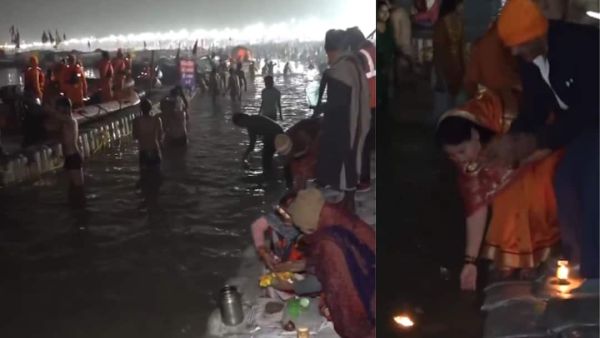
As dawn broke on Paush Purnima, the Sangam transformed into a vast ocean of faith, with thousands of devotees braving the winter chill to take the season’s first major holy dip. The sacred bathing ritual began in the early hours of Brahma Muhurta, when pilgrims started arriving in steady streams, driven by deep spiritual belief and age-old tradition. Authorities estimate that nearly 25 to 30 lakh devotees will immerse themselves in the confluence of rivers by the end of the day in Prayagraj.
This year’s Paush Purnima holds exceptional significance. The full moon appeared at 4 a.m., aligning with a rare celestial occurrence being witnessed at the Magh Mela after a gap of 75 years. With this auspicious moment, the month-long ritual of Kalpvas officially commenced, marking a period of austerity, prayer, and disciplined living for millions of devotees.
Shakambhari Purnima
Shakambhari Purnima is dedicated to Goddess Shakambhari and is observed in many parts of India. It is celebrated during the month of Pausha, typically corresponding to January in the Gregorian calendar.
The festival also signifies the final day of the eight-day Shakambhari Navaratri observance.
A Sacred Beginning To Kalpvas
Kalpvasis—those who observe a month of spiritual restraint—have begun settling across the sprawling fairgrounds. Officials expect around 20 to 25 lakh Kalpavasis to reside here, devoting their days to meditation, penance, and religious observance. Over the next one-and-a-half months, the Magh Mela is projected to draw an astonishing 12 to 15 crore pilgrims from across the country, especially on key bathing dates.
#WATCH | Prayagraj, UP | People take a holy dip at Triveni Sangam on the occassion of Paush Purnima, the first 'snaan' and also the first day of Magh Mela 2026. pic.twitter.com/2pp72Zib9z
— ANI (@ANI) January 3, 2026
Reflecting on the spiritual importance of the occasion, a Sadhu said, “This sacred gathering offers devotees a chance for purification, spiritual elevation, and divine blessings. Bathing on these holy days is believed to absolve sins and bring grace.”
Pilgrims Praise Arrangements Amid Massive Crowd
Despite the overwhelming turnout, many visitors expressed satisfaction with the facilities in place. One pilgrim remarked, “The turnout is immense, yet the arrangements are commendable. Security and facilities have been well managed.”
To support the influx, multiple government departments have coordinated large-scale preparations. A steady flow of 10,000 cusecs of water is being maintained, while temporary infrastructure—including roads, power supply, drinking water, and sanitation—has been rapidly expanded to meet daily demands.
Security, Healthcare & Logistics On High Alert
Healthcare services have been strengthened with hospitals, health centres, ambulances, and traditional medicine clinics stationed across the venue. Sanitation teams, supported by thousands of workers and modern waste-management systems, are operating round the clock. The fair spans 800 hectares across seven sectors, supported by extensive parking, transport services, and a dense security network featuring police units, fire services, water barricading, and AI-enabled surveillance cameras.
The Magh Mela calendar will continue with major bathing days including Makar Sankranti on January 15, Mauni Amavasya on January 18, Basant Panchami on January 30, Maghi Purnima on February 1, and Mahashivratri on February 15, each expected to draw massive crowds.
Contact to : xlf550402@gmail.com
Copyright © boyuanhulian 2020 - 2023. All Right Reserved.