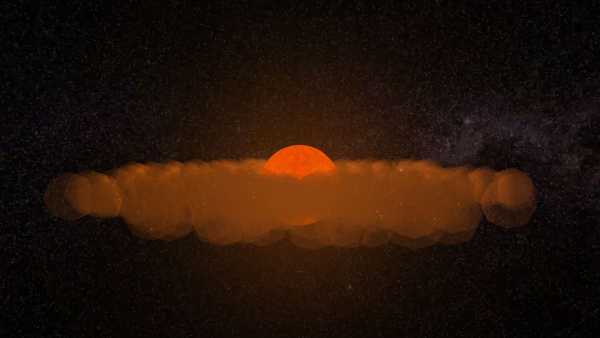
New Delhi: Indian astronomers have observed the partial collapse of the inner circumstellar wall of a newborn star designated as T Chamaeleontis (T. Cha) at a distance of 350 lightyears in the small southern constellation of Chamaeleon. The star is surrounded by a planet-forming disk of leftover gas and dust from the formation of the star, with a wide gap that is believed to be carved out by a newborn planet. The inner regions of such disks act as a barrier, blocking the energetic ultraviolet light from the star from reaching the colder, outer regions. This shielding allows for the formation of Poly Atomic Hydrocarbons (PAHs).
These are flat, honeycomb-shaped molecules made of carbon and hydrogen, thought to be the earliest precursors of the complex chemistry necessary to sustain life, because of the low amount of ultraviolet light produced by them. These PAHs are hard to detect under low-mass stars like the Sun. These molecules are common in interstellar clouds, the nurseries within which stars are formed. Scientists from the Indian Institute of Astrophysics used archival data from the James Webb Space Telescope to study PAHs surrounding T. Cha. When Webb turned towards the target in 2022, the inner wall had partially collapsed, allowing ultraviolet radiation to leak through.
A surprising coincidence
The hydrocarbon detection was possible because of the partial collapse of the inner wall in the accretion disk surrounding the newborn star. A paper describing the research has been published in The Astronomical Journal. One of the study authors, Arun Roy explains, “This sudden illumination excited the PAHs in the disk, making them glow strongly in JWST’s detectors. It was like a curtain lifting, revealing chemistry that had been hidden for years.” The signatures of the molecules were also present in older archival data captured by the retired Spitzer telescope. The researchers plan to revisit the system multiple times with the JWST, to track the evolution of the PAHs over time.
Contact to : xlf550402@gmail.com
Copyright © boyuanhulian 2020 - 2023. All Right Reserved.