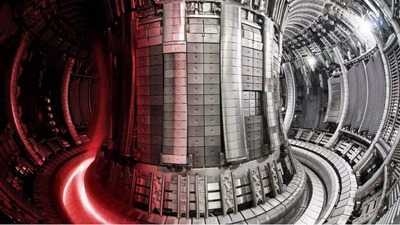
Fusion reactors may produce dark matter
29 Dec 2025
A team of international physicists has proposed that future fusion reactors could be a source of axions, hypothetical particles associated with dark matter.
The research, led by Jure Zupan from the University of Cincinnati and published in the Journal of High Energy Physics, explores how neutrons generated in these reactors might trigger rare reactions producing axions.
Axions: Theoretical particles that could explain dark matter
Dark matter mystery
Axions are theoretical subatomic particles that scientists think could help explain dark matter.
This mysterious substance is believed to make up most of the universe's mass, even though it has never been directly detected.
Its existence is inferred from the gravitational effects on visible matter, such as the unusual motions of galaxies and their stars.
One leading theory suggests dark matter is composed of extremely light particles like axions.
Fusion reactors could produce axions through neutron interactions
Production methods
The study by Zupan and his team looked at a fusion reactor design that uses deuterium and tritium fuel in a lithium-lined vessel.
Such a reactor would produce large amounts of neutrons along with energy. These neutrons could trigger nuclear reactions with materials in the reactor's walls, potentially creating new particles like axions.
Another method involves neutrons colliding with other particles and slowing down, releasing energy in a process called bremsstrahlung or "braking radiation."
Contact to : xlf550402@gmail.com
Copyright © boyuanhulian 2020 - 2023. All Right Reserved.