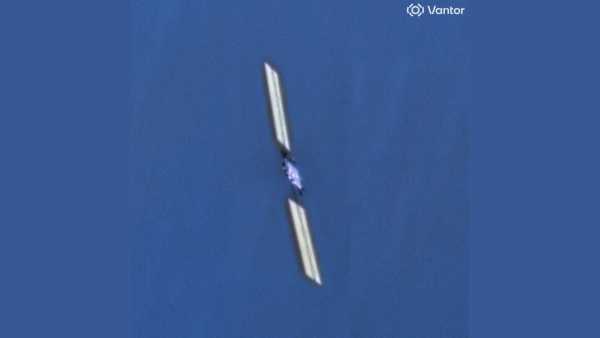
New Delhi: On 17 December, a Starlink satellite experienced an anomaly, which is confirmed to be a debris-producing event. There was a loss in communications, followed by the venting of the propulsion tank, a drop in altitude by around four km, and the release of a small number of low velocity objects. The US Space Force and NASA are monitoring the debris. The satellite was subsequently confirmed to be largely intact by a Vantor satellite. The satellite is expected to decay and burn up in the atmosphere within a few weeks.
VP of Starlink Engineering at SpaceX Michael Nicolls noted in a post on X, “Imagery collected by Vantor’s WorldView-3 satellite about 1 day after the anomaly shows that Starlink Satellite 35956 is largely intact. The 12-cm resolution image was collected over Alaska from 241 km away. We appreciate the rapid response by Vantor to provide this imagery. Additional data suggest that there is a small number of trackable debris objects from the event, and we expect the satellite and debris to reenter and fully demise within weeks.” There debris poses no threat to the orbital complexes in orbit around the Earth, the International Space Station and the Tiangong Space Station.
Non Earth Imaging
Vantor, formerly Maxar intelligence is one of the few private companies in the world with non Earth imaging (NEI) capabilities for providing Space Situational Awareness (SSA). While most satellites look down at the ground, the NEI satellites can look at other satellites in Earth orbit. Previously, Vantor has also captured the NISAR satellite shortly after it deployed its radar reflector antenna. The capabilities can also be used to assess the purpose and capabilities of adversarial satellites, and track their movements. In India, the Bengaluru-based New Space startup Digantara works on the forefront of the SSA domain, and has demonstrated NEI capabilities.
Contact to : xlf550402@gmail.com
Copyright © boyuanhulian 2020 - 2023. All Right Reserved.