Conscious Vaastu® reminds us that the way we design and inhabit our spaces directly shapes our wellbeing. Air and light are the most fundamental elements of life, yet in modern architecture this becomes a challenge. Cross ventilation — the simple principle of allowing air to move freely across a space through windows or openings on opposite sides — was once an important factor of home design. Ancient civilizations, from Indian palaces to Mediterranean villas, understood that the health of a dwelling depended on how air and light circulated within it. Today, however, many apartments are built with windows only on one side, limiting both airflow and energy resonance. This has consequences not only for physical comfort but also for mental balance and emotional wellbeing.
Ancient wisdom in architecture
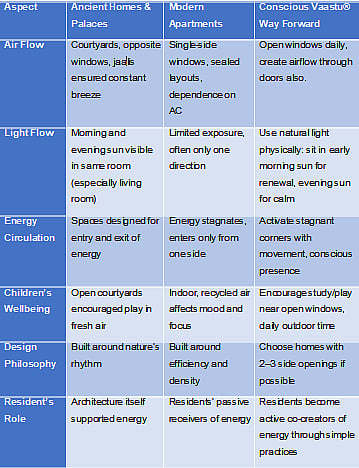
In traditional Indian homes, courtyards were central features. They acted as lungs of the house, drawing in fresh air and sunlight while allowing hot air to escape. Many palaces, for example, were designed with Jharokhas (overhanging balconies) and Jaalis (perforated stone screens) that facilitated airflow while reducing glare. Across cultures, the principle was the same: air must enter from one side and exit from another.
Modern decline
Fast forward to today’s urban apartments, and the story is very different. Most layouts provide windows only on one side of the building. Energy enters through these openings but stagnates because it has no exit. The result is stale air, dependence on artificial cooling, and diminished vitality. Children spend hours in rooms with recycled air from air conditioners, which affects their mood, concentration, and creativity. Adults too experience fatigue, irritability, and a subtle sense of confinement.
In Conscious Vaastu®, energy resonance is vital for clarity, peace, and wellbeing. When airflow is restricted, so is the vibrational quality of the space.
Ancient ventilation vs. Modern apartments
Choosing spaces wisely
If you are selecting a new home or workspace, look for layouts with windows on at least two to three sides. If you get space with windows on four sides that is considered the best. Such designs allow flow freely, creating a dynamic pattern that supports vitality. Even if the room is not aligned according to traditional Vaastu templates, the presence of multiple openings helps in better energy circulation. If you are building your own space, insist on cross ventilation in as many rooms as possible.
Conscious Vaastu: Understanding ‘The Energy We Carry’ And Its Hidden Effect On Our Daily LifePractical remedies
Here are conscious and simple remedies that avoid symbolic objects and instead rely on awareness, rhythm, and daily practice:
Air rituals
Open windows to invite fresh energy.
If only one side has windows, create airflow by opening the main door briefly.
Treat this as a ritual of renewal — pause, breathe, and acknowledge the shift.
Movement activation
Walk through your space consciously once or twice a day, ensuring energy doesn’t stagnate.
Encourage children to move between rooms rather than staying in one closed space.
Movement itself becomes a way of circulating energy.
Sun connection
Sit in the early morning sun for clarity and vitality.
Sit in the evening sun for calm and reflection.
If your room doesn’t get both, consciously step into another space or balcony at those times.
Children’s energy care
Encourage study/play near open windows.
Make “fresh air breaks” part of their routine — step outside or open windows for 10 minutes every few hours.
Seasonal adaptation
In summer, invite morning air for coolness.
In winter, invite evening air for warmth.
Align your ventilation habits with the season’s rhythm.
Conclusion
Cross ventilation is a forgotten element of modern architecture, yet it remains essential for health, energy, and peace. Whether through choosing spaces with multiple windows or activating energy intentionally in single-side layouts, the goal is the same: to live in harmony with natural flow. In embracing cross ventilation, we do more than improve airflow, we reconnect with ancient wisdom, honour natural rhythms, and create homes that truly breathe.
Dr Harshit Kapadia is a metaphysics consultant of Conscious Vaastu, Yuen Hom and Sam Hap Style of Feng Shui. To know more visit his website www.consciousvaastu.com
Contact to : xlf550402@gmail.com
Copyright © boyuanhulian 2020 - 2023. All Right Reserved.