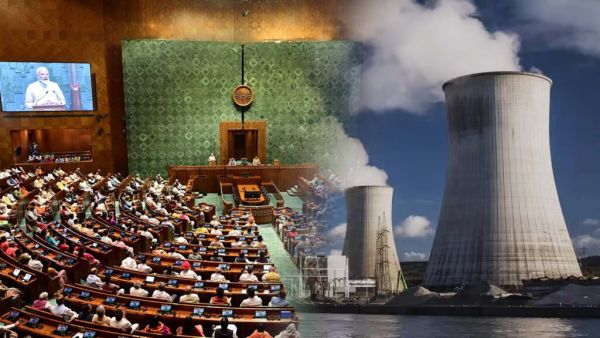
The Sustainable Harnessing and Advancement of Nuclear Energy for Transforming India (SHANTI) Bill, 2025, which proposes major changes to India’s nuclear energy framework, has been passed by the Lok Sabha and is likely to clear the Rajya Sabha as well.
The Bill allows private operators to run nuclear power plants and fixes liability in the event of a nuclear accident—moves that critics say raise serious concerns about accountability, costs, and public interest.
Two key changes
The bill introduces two significant shifts. First, it opens the door for private operators to run nuclear plants in India, though it remains unclear whether this will be through full private ownership or public-private partnership (PPP) models.
Second, it fixes the overall liability in the event of a nuclear disaster, including the liability of private operators. While liability provisions existed earlier, the new framework alters how responsibility is distributed between operators and the government.
Limited scrutiny
One of the first concerns raised is the lack of public and parliamentary scrutiny. The bill was not placed in the public domain for wider debate and did not go through examination by a parliamentary committee.
Also read: Why SHANTI Bill is a big risk: Yashwant Sinha speaks out
According to the Speaker, the debates in Parliament are largely procedural. Therefore, the debate that happened in the Lok Sabha, and the one that will probably happen in the Rajya Sabha, are mere formalities and suggestions are unlikely to be incorporated.
Liability cap explained
Under the bill, the maximum liability for a nuclear disaster is fixed at 300 million Special Drawing Rights (SDRs). One SDR equals about $1.36, which puts the total liability at roughly $410 million, or around Rs 4,000 crore.
The liability of a private operator is capped at Rs 3,000 crore for power plants with a generating capacity of more than 3,600 megawatts.
So, if an accident happens, the maximum liability is about Rs 4,000 crore, and the operator’s liability is Rs 3,000 crore. Who pays the rest? It’s the government, meaning the taxpayer.
Government takeover clause
The bill also allows the central government to take over a nuclear plant “in public interest” in the event of a disaster. In such cases, the entire liability would be borne by the government.
Also read: LS passes SHANTI Bill 2025 to target 100 GW by 2047; Opposition seeks JPC debate
What is this public interest? It is not defined in the law. Therefore, this clause effectively shifts the full burden of compensation onto taxpayers when invoked.
Comparison with 2010 law
A similar liability cap of 300 million SDRs was fixed in the Civil Nuclear Liability Act of 2010. Critics argue that the amount is outdated and should have been revised upward to account for inflation over the past 15 years.
This brings to mind the 1984 Bhopal gas tragedy, when a pesticide plant run by Union Carbide leaked methyl isocyanate gas. Union Carbide paid $470 million in compensation. In this bill, the maximum liability for a nuclear disaster is capped at $410 million.
Supplier liability removed
Another major change is the removal of the operator’s right to recourse. Under the 2010 law, operators could seek compensation from suppliers of nuclear equipment and materials.
Also read: Lok Sabha debates SHANTI Bill as India eyes 100-GW nuclear power by 2047
That clause has been removed. This means suppliers of nuclear equipment and material will have no liability at all under the new law.
High cost of nuclear power
The cost of nuclear energy is another key concern. According to estimates by the Central Electricity Authority, generating one megawatt of nuclear power costs around Rs 15–16 crore.
In comparison, solar, wind, and coal-based power projects cost well below Rs 10 crore per megawatt. Higher capital costs translate into more expensive electricity for consumers.
Nuclear plants are very costly to establish, and the power they generate will also be very costly.
Green energy paradox
The push for nuclear energy is being justified as part of India’s green energy transition. However, critics say this argument ignores existing capacity and infrastructure gaps.
India already has about 52 per cent of its installed electricity capacity from green sources, mainly solar and wind. Nuclear power contributes only about 8.7 gigawatts.
Also read: India’s nuclear push comes with a catch: Absurdly low liability, unlimited public risk
Despite this, only around 24 per cent of installed green capacity is actually utilised. The reasons include inadequate transmission lines, insufficient distribution infrastructure, and lack of storage facilities for intermittent energy sources like solar and wind.
We don’t have enough money to evacuate and utilise the green energy capacity we already have. So why go for even costlier nuclear energy?
PPP concerns
The bill’s reliance on private participation also raises doubts based on past PPP experiences. Many infrastructure projects under the PPP model have been heavily funded by government support and bank loans rather than private capital.
PPP projects often receive up to 40–45 per cent viability gap funding from the government, with the remaining costs financed by bank loans—largely from public sector banks. So the money is not private investors’ money; it is taxpayers’ money and people’s bank deposits.
Also read: Atomic Energy Bill 2025: Why India’s 100 GW nuclear mission is a distant dream | Interview
Given that private investment has remained low despite high corporate profits in recent years, expecting significant private funding for nuclear projects may be unrealistic.
Rushed legislation
Overall, the bill is being pushed through Parliament too quickly, without adequate consultation or scrutiny, despite its far-reaching implications, which does not make any sense. The Opposition’s objections are valid, even though the bill is likely to be passed.
Also read: Atomic Energy Bill: What it means to allow private firms into India’s nuclear sector
With low liability caps, undefined “public interest” provisions, and no accountability for suppliers, the burden of any future nuclear disaster will ultimately fall on Indian taxpayers.
(The content above has been transcribed from video using a fine-tuned AI model. To ensure accuracy, quality, and editorial integrity, we employ a Human-In-The-Loop (HITL) process. While AI assists in creating the initial draft, our experienced editorial team carefully reviews, edits, and refines the content before publication. At The Federal, we combine the efficiency of AI with the expertise of human editors to deliver reliable and insightful journalism.)
Contact to : xlf550402@gmail.com
Copyright © boyuanhulian 2020 - 2023. All Right Reserved.