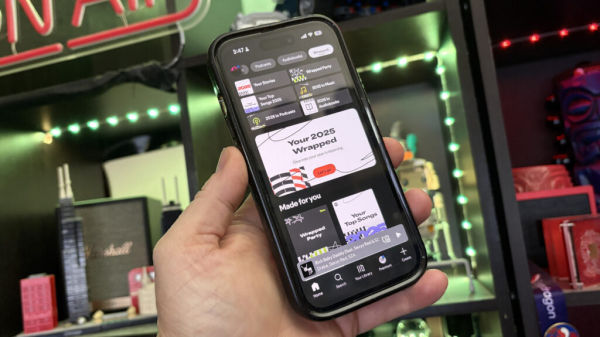
As the new year approaches, it’s hard not to reflect on how we spent our time over the past twelve months. It’s even easier to look back with things like Spotify Wrapped giving us a snapshot of our past year in sound. But, for some, their musical retrospectives didn’t quite meet expectations. As graphics of listeners’ top songs and artists flooded Instagram, concerned posts also spread across Reddit, with users highlighting possible inaccuracies in their end-of-year rundown. Some shared that their top artists included bands they couldn’t name a single song by, while others’ top genre lists were littered with unfamiliar, and in some cases, unfavorable, styles. Naturally, these possible inaccuracies raised alarm bells.
I had a similar creeping suspicion during last year’s Wrapped season, after a couple of years of surprises, prompting me to take matters into my own hands. So, I tracked my streaming habits for a whole year. Come December, my suspicions were confirmed: my listening stats didn’t match my Spotify Wrapped. In fact, my top songs showed a vastly different order, with different songs making it to the top five.
Some differences between the two platforms’ records were subtle. A couple of songs switched places here and there, with my top song on Spotify hovering around second place. Other differences were more noticeable; with whole albums I spent a lot of time with missing entirely. What really struck me, though, was that there was no single date in November — the cut-off point for Wrapped — where my top songs exactly matched what Wrapped gave me. Much like many other music fanatics, this led me to question not only Wrapped’s accuracy, but also its validity.
How I measured my streaming habits
On January 1st, 2025, I set up a fresh Last FM account to start collecting data from my Spotify streams. Then, I listened as I usually would. Toward the end of the year, when my Spotify Wrapped dropped, I compared it against the data logged by Last FM throughout the year. I was careful not to exclude anything from my taste profile, and didn’t use any private listening sessions, so the data gathered was as complete and representative of my listening as possible.
I only tracked my listening through my own Spotify account with Last FM to help make sure my comparison to Wrapped was as fair as possible. That means the time I spent listening to LPs, Bandcamp, the radio, or via my partner’s profile in the car wasn’t counted. This helped me to see if my surprise really was just me being duped by hearing a record 100 times and not seeing it reflected in my Wrapped.
I also played around with the period of time covered by Last FM to try and capture the Wrapped cut-off point as closely as possible. Spotify stopped gathering wrapped data in mid-November, but no specific date was publicized, so I had to estimate. Per the BBCthe cut-off point in 2024 was November 15th, so I used that as a jumping-off point and experimented with other dates to see if it made a difference.
What is Last FM?
II.studio/Shutterstock
Last FM is basically tracking software that automatically records your listening habits. It’s a straightforward, old-internet-style platform that creates a relatively comprehensive record of the music you listen to through anything you’ve integrated with it. It can scrobble music you stream, listen to via media players, and more. Scrobbling, by the way,is when Last FM records data from your listening habits. For example, it makes a note of what song you listened to and when. You can even use special software like OpenScrobbler to manually scrobble tracks you heard while streaming on a different platform.
Last FM saw its peak around the 2010s when I was mostly listening to music via iTunes. I left the platform after a while because it seemed to miss a lot of data. I’m happy to report is has adapted to streaming services well and, because of that, it has vasty improved.
It isn’t the most well-known platform these days, it still has a reasonably sized user base. That’s easy to tell from the Last FM charts, with top artists like BTS, Rihanna, Chappell Roan, and The Weeknd each sweeping up multi-million listeners figures. The appetite for the platform likely stems from the same urge we have to sift through our Wrapped: it offers us the chance to get a deeper understanding of how we behave, and what we like. Plus, with Last FM, you can see your Spotify stats whenever you feel like it.
Spotify’s metrics and methods could skew your data
Spotify shared its methods for measuring and analyzing Wrapped, and what guardrails they put in place to make the magic happen. One rule is that songs must be streamed for at least 30 seconds to count. Meanwhile, certain types of tracks are filtered out altogether, with “background sounds and white noise” given as examples. In some ways, this makes sense. You don’t want your nightly noise machine bungling your Wrapped stats. However, it’s not clear exactly what’s impacted by this, meaning it’s possible that genres like ambient or harsh noise could be unfairly disqualified from Wrapped. We also know that Wrapped isn’t the best at dictating genre, so tracks could be swept away inaccurately.
Spotify also stops collecting Wrapped data in November. It’s likely to stop holiday tunes from creeping in and to provide time for number crunching. But, that still means around six weeks of listening are lost each year. Personally, I don’t listen to much Christmas music, and I’d much prefer Vince Guaraldi getting into my Wrapped over losing my listening habits from more than 1/12th of the year. How else am I going to remember what I loop while working through the year-end crunch? Plus, anything excluded from your taste profile is already Wrapped-exempt, so holiday music could just be tagged like that.
While these guardrails are intended to improve user experience, they all lead to a significant consequence, and it’s not just that your Wrapped data isn’t completely numerically accurate. It’s also that this cherry-picked data might not be representative of your true listening habits. Say that you do listen to a lot of coffee shop sounds, or Last Christmas on repeat — disregarding that might mean your behavior isn’t being accurately represented.
Spotify’s album stats are off
A few areas stood out when looking through my Wrapped and Last FM data, but perhaps the most glaring was the top album stats. My top albums were almost completely different. My first and third albums were correct, but the other three highlighted by Spotify were all wrong. My second-most-streamed album should have been my fourth, with my true second-most-listened-to album being omitted from Wrapped altogether.
Per Last FM, and my memory of 2025, my second top album should’ve been Jack Stauber’s “Micropop”: an experimental, independent album with 99 songs. While the songs are short, they’re all at least 30 seconds. Despite that, the album was nowhere to be seen. Spotify states that calculating top albums for Wrapped uses its “own unique logic“. But, for something to be completely omitted makes it seem like something has gone wrong, especially when other, non-typical albums are missing, too. Meanwhile, I technically only heard my third top album in full once.
My fifth top album was similarly excluded — this time, a soundtrack album. When I’m not covering tech, I moonlight as an entertainment reporter, so I listen to a lot of soundtracks. Consequently, I feel it’s representative of my tastes for at least one to make it into the mix. However, Wrapped replaced it with a contemporary album. This is the second soundtrack- exclusion I noticed, with one of my top songs being an instrumental film score replaced with a contemporary song instead. Spotify isn’t filtering out original soundtracks altogether — KPop Demon Hunters was the second top album globally — but perhaps Wrapped struggled to handle unusual takes on the album format.
Different platforms have different approaches, but questions still remain
As Spotify made clearit’s impossible to compare different platforms’ data with 100% accuracy. Companies design their data collection differently depending on ethos, approach, and what they believe creates the best user experience. Despite that, some differences were still stark enough to raise questions.
One figure from my Wrapped was a stand-out example of this: the number of albums listened to in a year. Spotify’s suggestion made me raise an eyebrow. Apparently, I had listened to 28 albums throughout 2025. I would’ve guessed I heard more in their entirety, but it’s a plausible number — except for the fact that Last FM suggests I’ve scrobbled around 1,600 albums. This is a clear example of different platforms logging data differently. Spotify, on one hand, is likely counting an album stream as listening from front to back, while Last FM is counting it based on how many different albums you’ve scrobbled a song from.
That difference still doesn’t mean that Spotify’s album tracking is wholly accurate. I spoke to someone who tracks their album listening manually using a spreadsheet, also prompted by suspicions about Wrapped’s accuracy. They update their spreadsheet every time they stream an album in full, creating a listening database. The gulf between the figure provided by Spotify and their spreadsheet was narrower, but still existed. Their records showed they had listened to 358 albums in full by November 16th, while Spotify Wrapped claimed they only streamed 344. Of course, this error could be chalked up to anything from incorrect logging to offline listening, especially without further transparency around how Wrapped’s data is collected.
Algorithmic listening shapes your behavior before it makes it to Wrapped
Right now, it’s hard to say if Wrapped’s idea of your top music is truly valid. Partially because of many user reports of inaccurate Wrappeds, and partially because Spotify’s algorithmic listening is predicting and dictating your behavior the whole time it’s gathering data.
One of Spotify’s best-known features is its intelligent algorithms, which shape your pre-made playlists, pick the songs you find on your Discover Weekly, and generate endless radio stations to your recent listens. It’s easy to finish an album and slip into an infinite autoplay of Spotify’s selections. So much so that it might even make up a larger amount of what you stream than you realize. When this happens, Wrapped isn’t necessarily validly recording your tastes, how you engage with audio, or the albums that have had the biggest impact on your year. Instead, it’s at least partly measuring what it’s served up to you regularly over the months.
That’s not to say you have no choice in what you listen to, or any control over your Wrapped. You still choose what to tune into, and you can even use workarounds to make Spotify’s shuffle feature more random and less algorithmically-driven. But, unless you’re super conscious of your listening habits, it’s more than likely that some of your end-of-year figures are going to be at least a little shaped by Spotify’s own systems, rather than being a perfect picture of your true top music from the past year.