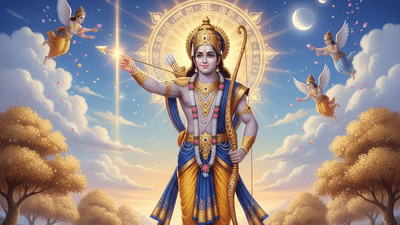
Hindu scriptures and Puranas divide time into four eras: Satya Yuga, Treta Yuga, Dwapara Yuga, and Kali Yuga. These eras not only change religion, conduct, and lifestyle, but also significantly differ in the nature of human longevity and death. Let's explore these aspects according to the scriptures.
Hindu Yugas Death Concept: The four Yugas described in Hinduism and Puranas, Satya Yuga, Treta Yuga, Dwapar Yuga, and Kali Yuga, show a vast difference not only in the moral conduct of humans, but also in their lifespan and the nature of death. In the present Kali Yuga, where even living for 100 years is considered rare, in the era of Lord Rama, i.e. Treta Yuga, people lived for 10,000 years. The question arises: when humans lived for 10,000 years, was the nature of death the same as in today's Kali Yuga? Let us understand this mystery in detail based on Hindu scriptures.
What was the age of humans in Treta Yuga?
According to the Puranas, the average human lifespan in the Treta Yuga was approximately 10,000 years. At that time, the body was strong, disease-free, and long-lived. For example, many texts mention King Dasharatha's lifespan as being 60,000 years. Lord Rama ruled the earth for approximately 11,000 years. This presents a stark contrast to today's human lifespan, where even a hundred years is considered an exception.
Was there death in that era too?
Death occurs in every age, but its form in the Treta Yuga was not as pronounced as in the Kali Yuga. According to scriptures, premature death (death at a young age) was very rare at that time. Deaths from common diseases, epidemics, or mental stress were almost nonexistent. Most people died after living to their fullest.
Euthanasia and a disease-free body
In the early periods of the Satya Yuga and Treta Yuga, the concept of voluntary death was prevalent. This meant that individuals could choose their own time of death upon reaching the age of majority. Bodies were so healthy and balanced that serious illnesses were not a problem until old age. Death was not painful, but rather peaceful and conscious.
What were the major causes of death?
- In Treta Yuga, death mainly occurred due to three reasons.
- Perfect old age (when the purpose of life is fulfilled)
- Dharma Yudh (to protect Dharma)
- curse or divine providence
Unlike today, death due to minor illnesses, pollution or lifestyle diseases were considered very rare in that era.
Jal Samadhi and voluntary death
The deaths of Lord Rama and his brothers are not considered ordinary deaths. According to scriptures, after completing his incarnation, Lord Rama took samadhi in the Sarayu River. This renunciation occurred voluntarily and with full consciousness. This is considered completely different from today's natural or accidental deaths.
Decreasing human lifespan by eras
It is clearly stated in the Puranas that as Dharma (virtuous deeds) decreases and sinful deeds increase, the lifespan of a human being also decreases.
- Satya Yuga: 1,00,000 years
- Treta Yuga: 10,000 years
- Dvapara Yuga: 1,000 years
- Kali Yuga: Average 100 years
What is the difference if we compare it with Kaliyuga?
In today's Kali Yuga, untimely death is common; disease, stress, accidents, and mental imbalances have increased, making life short but complex. In the era of Lord Rama, life was long, balanced, and purposeful. Death was not feared but considered a natural phase. People departed with dignity and peace. Therefore, in the era of Lord Rama, death was not as sudden, painful, or frightening as in the Kali Yuga. People lived long lives, fulfilled their dharma and duties, and departed peacefully. This is why Treta Yuga is still considered a symbol of an ideal life and an ideal death.
Disclaimer: The information in this news is based on religious beliefs and general information. NewsCrab does not endorse it.
PC:TV9Bharatvarsh
Contact to : xlf550402@gmail.com
Copyright © boyuanhulian 2020 - 2023. All Right Reserved.