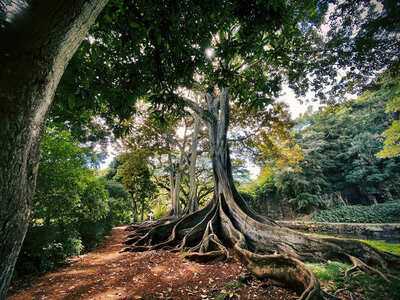
Why Hanuman Ji Is Worshipped Near Peepal Trees
When people see Hanuman Ji worshipped near a Peepal tree, they often assume it is tradition carried forward without thought. But practices that survive thousands of years rarely do so by accident. They stay because they work, emotionally, psychologically, spiritually, and socially. This pairing of Hanuman and the Peepal tree is not decorative. It is instructional. It teaches something essential about how strength must be lived if it is to last.
The Peepal Tree Is Not Worshipped for Mystery, But for What It Represents
In Hindu thought, the Peepal (Ashvattha) is not sacred because it is unusual, but because it reflects life accurately. Scriptures describe the Ashvattha as a cosmic tree - one whose roots, trunk, and branches represent the unseen source, the visible world, and the endless spread of cause and consequence. In the Bhagavad Gita, Krishna refers to the Ashvattha to explain existence itself: life appears rooted upward, while humans experience it downward, through actions and results.
This matters because the Peepal stands for continuity - life that persists quietly, without drama. It survives storms, heat, neglect, and time. It does not move, yet it influences everything around it. The Peepal teaches one truth: real power is not loud; it is enduring.
Hanuman Represents Strength That Knows Its Place
Hanuman Ji is often misunderstood as a symbol of raw power. In reality, he is the opposite of uncontrolled force. He is strength that is aware, directed, and restrained. In the Ramayana, Hanuman never acts for himself. He does not seek recognition. He does not fight to dominate. Every action flows from clarity of purpose and surrender to something larger than his ego.
This makes Hanuman different from most heroic figures. His greatness lies not in what he can do, but in when he chooses to act and when he chooses not to. That kind of strength needs grounding. Without roots, power becomes arrogance. Without stillness, courage becomes chaos.
Why the Two Must Exist Together

Placing Hanuman near the Peepal tree is not symbolic coincidence; it is a balance lesson The Peepal stands still. Hanuman moves. The Peepal endures time. Hanuman responds to crisis. The Peepal represents being. Hanuman represents doing. Human life constantly swings between these two states. We are either acting without reflection or reflecting without action. The pairing teaches that strength must grow from stillness, and stillness must eventually express itself through action.
This is why devotees instinctively feel calm yet focused in such spaces. The setting itself communicates what words often fail to teach: be rooted before you try to be powerful. Safety in turmoil (Hanuman as protector), constancy in change (Peepal as perennial anchor), and a practical structure for moral formation (small, repeated practices that build courage and restraint)
What This Teaches About Everyday Human Struggle
Most people who pray to Hanuman are not seeking miracles. They are facing very ordinary battles: fear, exhaustion, responsibility, pressure, self-doubt. The Peepal tree absorbs heat, offers shade, shelters life. It does not ask who deserves relief. It simply gives. Hanuman mirrors this through service - strength that exists not to prove itself, but to protect and support.
Together, they quietly answer a universal human question: How do I stay strong without losing myself? The answer is not aggression, nor withdrawal. It is rooted action, remaining connected to something steady while doing what must be done.
Not a Ritual, But a Life Instruction
Hanuman Ji being worshipped near the Peepal tree is not about fear, superstition, or blind belief. It is about how humans are taught to live. Stand firm like the Peepal. Act decisively like Hanuman. Let your strength rise from clarity, not restlessness. That is why this practice has survived. It doesn’t just ask for devotion, it quietly trains character. And that is why, even today, people stop beneath a Peepal tree, fold their hands before Hanuman, and leave feeling steadier than when they arrived, not because something magical happened, but because something true was remembered.
The Peepal Tree Is Not Worshipped for Mystery, But for What It Represents
Peepal symbolizes continuity, stability, cosmic life structure.
In Hindu thought, the Peepal (Ashvattha) is not sacred because it is unusual, but because it reflects life accurately. Scriptures describe the Ashvattha as a cosmic tree - one whose roots, trunk, and branches represent the unseen source, the visible world, and the endless spread of cause and consequence. In the Bhagavad Gita, Krishna refers to the Ashvattha to explain existence itself: life appears rooted upward, while humans experience it downward, through actions and results.
This matters because the Peepal stands for continuity - life that persists quietly, without drama. It survives storms, heat, neglect, and time. It does not move, yet it influences everything around it. The Peepal teaches one truth: real power is not loud; it is enduring.
Hanuman Represents Strength That Knows Its Place
Hanuman Ji is often misunderstood as a symbol of raw power. In reality, he is the opposite of uncontrolled force. He is strength that is aware, directed, and restrained. In the Ramayana, Hanuman never acts for himself. He does not seek recognition. He does not fight to dominate. Every action flows from clarity of purpose and surrender to something larger than his ego.
This makes Hanuman different from most heroic figures. His greatness lies not in what he can do, but in when he chooses to act and when he chooses not to. That kind of strength needs grounding. Without roots, power becomes arrogance. Without stillness, courage becomes chaos.
Why the Two Must Exist Together
Balance between stillness (Peepal) and action (Hanuman).
Placing Hanuman near the Peepal tree is not symbolic coincidence; it is a balance lesson The Peepal stands still. Hanuman moves. The Peepal endures time. Hanuman responds to crisis. The Peepal represents being. Hanuman represents doing. Human life constantly swings between these two states. We are either acting without reflection or reflecting without action. The pairing teaches that strength must grow from stillness, and stillness must eventually express itself through action.
This is why devotees instinctively feel calm yet focused in such spaces. The setting itself communicates what words often fail to teach: be rooted before you try to be powerful. Safety in turmoil (Hanuman as protector), constancy in change (Peepal as perennial anchor), and a practical structure for moral formation (small, repeated practices that build courage and restraint)
What This Teaches About Everyday Human Struggle
Most people who pray to Hanuman are not seeking miracles. They are facing very ordinary battles: fear, exhaustion, responsibility, pressure, self-doubt. The Peepal tree absorbs heat, offers shade, shelters life. It does not ask who deserves relief. It simply gives. Hanuman mirrors this through service - strength that exists not to prove itself, but to protect and support.
Together, they quietly answer a universal human question: How do I stay strong without losing myself? The answer is not aggression, nor withdrawal. It is rooted action, remaining connected to something steady while doing what must be done.
Not a Ritual, But a Life Instruction
Hanuman Ji being worshipped near the Peepal tree is not about fear, superstition, or blind belief. It is about how humans are taught to live. Stand firm like the Peepal. Act decisively like Hanuman. Let your strength rise from clarity, not restlessness. That is why this practice has survived. It doesn’t just ask for devotion, it quietly trains character. And that is why, even today, people stop beneath a Peepal tree, fold their hands before Hanuman, and leave feeling steadier than when they arrived, not because something magical happened, but because something true was remembered.
Contact to : xlf550402@gmail.com
Copyright © boyuanhulian 2020 - 2023. All Right Reserved.