
I thought I knew what to expect: A calm swim, maybe a glimpse of a fin slicing through turquoise water. But nothing prepared me for the moment I looked down and saw a whale shark — the size of a minibus — gliding just beneath the surface of the Indian Ocean. Silent, massive, and utterly graceful, it made me realise how small we are in the ocean’s scale.
The encounter recently happened off Jumeirah Thanda Island, a private island inside Tanzania’s Shungimbili Island Marine Reserve. The area is famous for its coral reefs and marine life, and one of the island’s experiences lets guests swim with whale sharks during the migration season.
Before we went out, Rianne Laan, the island’s resident marine biologist, briefed us. “They can grow up to 20 metres,” she said, “but the ones we see here are about 8 to 10 — still pretty big.” She told us not to worry. “They’re peaceful animals. Despite their size, they only feed on small fish and plankton.”
Rianne Laan, the island resident marine biologist
We headed out in two boats, each with a walkie-talkie to coordinate sightings. It felt like a safari, except this one was in the middle of the Indian Ocean. A local Tanzanian spotter stood at the bow, scanning for colour changes on the water, a shadow, a brownish tint, or the faint outline of a tail. To us, the sea looked the same everywhere. To them, it was a field of clues.
Rianne explained that whale sharks stay in these waters between October and February, when plankton is most abundant. “For years, people thought they migrated,” she said. “Turns out they don’t go far, they just move deeper down.” Researchers track them through acoustic and satellite tags, identifying each one by the unique pattern of white spots on its body, “like a fingerprint,” she added.
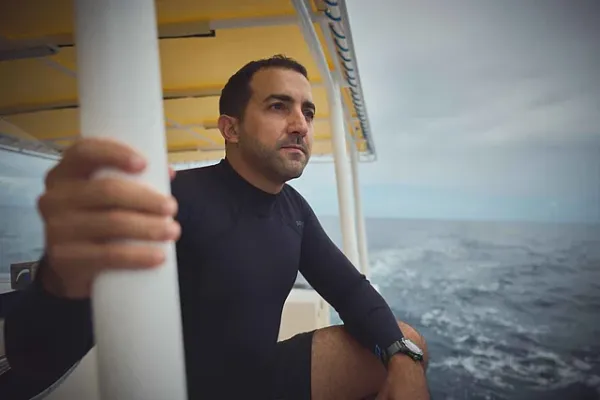
Sheikh Fahim bin Sultan Al Qasimi
Maya de Villiers, the island’s captain and operations manager, gave one last instruction. “Keep your fins and mask ready. When we tell you to go, slide in quietly. The less noise, the better,” she said. “Their one defense is their size and their ability to keep swimming without ever needing to breathe air. If they sense disturbance, they’ll dive down, down, down until you can’t see them anymore. So being calm and quiet is the best thing you can do for yourselves."
After about 30 minutes, the radio crackled. The engines slowed. “Get ready,” Maya said. “Go now.”
The moment I hit the water, everything went quiet. I looked down and there it was, a massive whale shark, just a few metres away, moving slowly through the blue. Its skin shimmered with white spots, its movement steady and calm. Around me, a dozen people floated, barely breathing, afraid to break the silence.
It didn’t care that we were there. It just kept swimming.
Back on the boat, no one said much. We all stared at the horizon, trying to process what we’d just seen.
The whale shark was the size of a mini bus, gliding just beneath the surface of the Indian Ocean. Even from above, its speed was unbelievable. Every time it disappeared, we would climb back into the boat, circle around, and jump again — hoping for another glance.
That night, over dinner on the island, we spoke with Sheikh Fahim bin Sultan Al Qasimi, who had joined the trip to highlight Jumeirah's conservation work — from turtle rehabilitation in Dubai to marine protection in Tanzania. “We are guests in their home,” he said. “We have to remember that every time we enter the water.”
Five days on Thanda Island showed how travel can be more than comfort. It can teach humility, perspective, and respect for the world beneath the surface. Swimming with a whale shark wasn’t just a tick on a travel list — it was a reminder that in the ocean, we’re the visitors.
Andaman's Intertidal Walk: Discover Havelock Island's hidden marine life UAE: How this royal went from fearing the sea to becoming 'Turtle Sheikh'Contact to : xlf550402@gmail.com
Copyright © boyuanhulian 2020 - 2023. All Right Reserved.