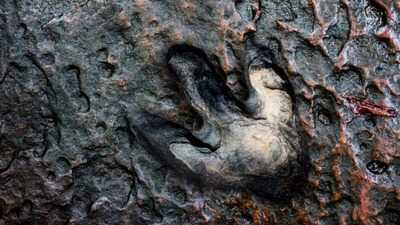
16,600 fossil footprints: Scientists discover largest dinosaur gathering ever
07 Dec 2025
In a groundbreaking discovery, scientists have unearthed the largest collection of dinosaur footprints ever found.
The site, known as Carreras Pampa in Bolivia's Torotoro National Park, is home to an astonishing 16,600 tracks. All of these were made by theropods, the predatory cousins of Tyrannosaurus rex.
The discovery is changing our understanding of prehistoric life and ecosystems during the Late Cretaceous period.
Unique characteristics of Carreras Pampa site
Site specifics
Unlike other fossil sites that usually feature a mix of herbivores and carnivores, Carreras Pampa is unique in its sole display of carnivore prints.
The footprints, preserved in Maastrichtian-era soil just before the dinosaurs' extinction, range from less than 10cm to over 30cm in size.
This exclusive collection gives researchers a rare glimpse into the behavior and movement patterns of these predatory species.
Evidence of dinosaur swimming behavior
Swimming tracks
The Carreras Pampa site also contains 280 swim pathways, 289 solitary prints, and 1,321 continuous trackways on a single stratigraphic surface.
Over 1,378 swim footprints were recorded by the study. Some showed alternating left-right limb movement, direct evidence of dinosaur swimming behavior.
This rare occurrence in the fossil record was published in Communications Biology and provides new insights into how these creatures navigated their environment.
Footprints reveal more about dinosaur behavior
Behavioral insights
The footprints at Carreras Pampa also show toe splay, tail drag marks, and even small turns or stops.
These details are preserved in great detail due to the carbonate-rich substrate and low-energy depositional environment.
Some of the deepest impressions indicate larger creatures pushed into soft mud while shallow ones hint at lighter creatures or harder terrain nearby.
Mystery of predator-only gathering at Carreras Pampa
Ecological enigma
All documented tracks at Carreras Pampa come from bipedal carnivores.
The ecological reason for this gathering of predators is still a mystery.
The study team highlights some hypotheses such as a behaviorally separated hunting area or scavenger aggregation near a declining water source but none can explain the absence of prey species over an area of about 7,500 square meters.
Contact to : xlf550402@gmail.com
Copyright © boyuanhulian 2020 - 2023. All Right Reserved.