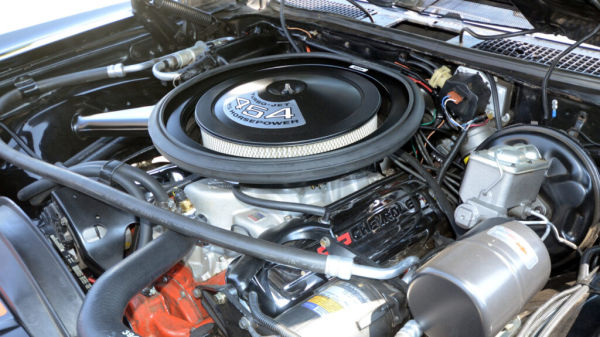
How big is one cubic inch? In physical size? Tiny, obviously. Even in terms of engine displacement, which we are about to discuss, a single cubic inch is almost nothing. It’s an amount regularly rounded over several times in the modern era of using liters to advertise displacement. Back in the late 1960s and early ’70s, at the height of the original American muscle car era, when displacement ruled and performance branding was everything, GM’s muscle car engineers saw themselves more as rivals than friends. In that era, a single cubic inch on a V8-powered muscle car could mean everything.
That’s what brings us to this little tale of two different flagship muscle car V8s — the Chevrolet 454 and the Pontiac 455. Both were made by General Motors, both were being built at the same time, and both had nearly identical displacement. In practice and DNA, however, they were totally different animals.
They weren’t just differentiated by brand names or ratings, they were two entirely different engines that shared almost no parts.Both engines are among the greatest big block V8s of all time, and looking back on these engines the 454 vs. 455 matchup is like a time portal to a bygone era of American engine building and GM’s corporate structure.
The peak of the horsepower wars

Wirestock/Getty Images
Before you look at why these two V8s differ so much, it’s important to understand that General Motors in the ’60s and ’70s was not the GM of today. Not only did GM have a lot more brands, but those brands were more like divisions.
Most of the basic platforms and body styles were shared under the same corporate umbrella, as were transmissions and basic suspension components, but under the hood, the engines were unique. GM’s brands didn’t just have their own versions of a corporate engine, in most cases, they made their own unique engines. Sometimes the displacements would be different, and sometimes they’d be exactly the same — like in the case of the Pontiac 350 and the Chevrolet 350 engines.
In 1970, not only were GM’s brands pushing the displacement of their engines to new heights, GM finally lifted its company-wide ban of engines over 400 cubic inches in intermediate cars — the ones most of the popular muscle cars were based on. 1970 saw the debut of the Pontiac 455 as an evolution from the Pontiac 428, and Chevy’s new 454 V8 as an upgrade from the 427. Even better, for the first time, Pontiac and Chevy could offer these enlarged V8s in the mid-sized GTO and Chevelle SS, respectively. Of course, Buick and Oldsmobile also had their own 455 engines, and those could be equipped on the mid-sized Regal GS and 442, respectively.
Which is the real big block?

JoshBryan/Shutterstock
It’s not just that the 454 and 455 don’t share parts. More so than internal specifications or horsepower figures, which varied depending on models and options, the biggest difference is between the 455 and the 454 is that the Pontiac 455 is not actually a big block engine. Yes, both represented the maximum displacement of their respective brands, but the actual DNA of the engines is entirely different.
The Chevy 454 is a true big-block engine, different dimensionally from the small-block Chevy V8, and following a lineage that includes the 396, 427, and other Chevy big blocks. The Pontiac 455 was not a big block, nor was it a small block. All of Pontiac’s V8s in the ’60s and ’70s were variations of the same engine family with the same dimensions just with different bores and strokes. This shared design is actually what allowed Pontiac to easily drop a 389 into a mid-sized Tempest in 1964 to create the GTO in the first place,
The Pontiac 455 would end up having a relatively short lifespan; it stuck until the mid-1970s, until it, like so many of the great muscle car era engines, were phased out in the face of tightening emissions regulations. The big block Chevy 454 would stick around a lot longer –all the way until 2001 to be exact, though after the mid ’70s it was used only by trucks and SUVs.