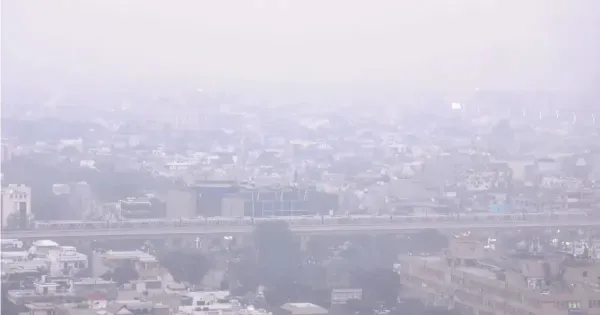
Delhi woke to clearer skies on Monday, yet the city’s overall Air Quality Index (AQI) remained in the ‘poor’ category, touching 300—slightly worse than Sunday’s 279 reading. Despite the deterioration, the capital experienced significant relief over the weekend as strong northwesterly winds helped disperse pollutants, ending a 24-day streak of ‘very poor’ air quality.
Air Quality in Delhi Sees Modest Decline
According to the Central Pollution Control Board’s (CPCB) Sameer app, 23 out of 38 monitoring stations recorded AQI levels in the ‘very poor’ category on Monday morning.
The CPCB classifies AQI levels as:
0–50: Good
51–100: Satisfactory
101–200: Moderate
201–300: Poor
301–400: Very Poor
401–500: Severe
Nehru Nagar recorded the worst AQI in the city at 354, followed by Rohini (343), Bawana (339), RK Puram (338), and Mundka (330). NSIT Dwarka reported the best air quality at 202, still in the ‘moderate’ range.
Clear Skies Credited to Strong Winds
Meteorologists attributed Sunday’s improved air quality to strong northwesterly winds that swept across Delhi, Punjab, and Haryana.
“We had strong winds blowing from the mountains towards the plains, which helped disperse pollutants not just across Delhi but the neighbouring states as well,” said weather expert Ashwary Tiwari of the IndiaMetSky portal.
CPCB wind data showed continuous 10–15 km/hr winds from Saturday afternoon with no nighttime stagnation, improving dispersion of pollutants that had accumulated over the previous three weeks.
Delhi Shivers at 5.7°C, Coldest Morning of the Season
Delhi’s Safdarjung weather station recorded a minimum temperature of 5.7°C on Monday—4.6°C below normal—marking the coldest morning of the season and the lowest November temperature since at least 2022.
Earlier on November 26, Delhi had recorded its coldest November temperature in three years, with the mercury dipping to 8°C.
Clear skies and strong winds contributed to both improved visibility and the sharp dip in night temperature.
Contact to : xlf550402@gmail.com
Copyright © boyuanhulian 2020 - 2023. All Right Reserved.