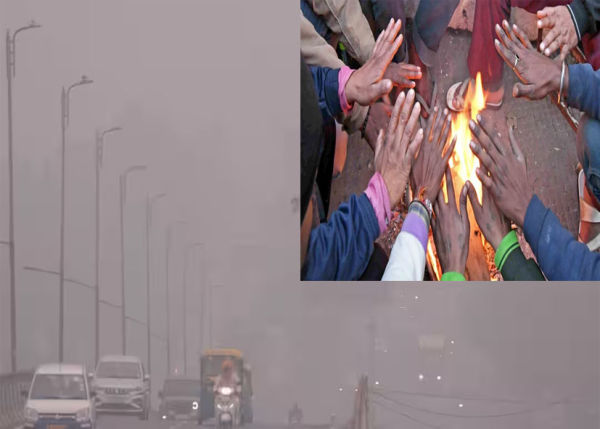
With the beginning of December, severe cold has hit the capital Delhi. On Monday, the minimum temperature in many areas was recorded 4.5 degrees Celsius or more below normal. The Meteorological Department has issued a yellow alert of cold wave for the next three days. On the other hand, poisonous air has also worsened the situation. It is estimated that Delhi is unlikely to get respite from the suffocating air for the next four days.
This time the month of November was colder than normal in Delhi. Initial snowfall in the higher Himalayan regions due to Western Disturbance and subsequent cold winds blowing from the same direction dropped the temperature across North India including Delhi. After November, now the cold trend continues in December also.
No relief from suffocating air for 4 days
As the wind speed decreases, Delhi’s pollution level has once again reached ‘very poor’ category. According to the Central Pollution Control Board, the air quality index (AQI) of the capital stood at 300 on Monday. It is estimated that Delhiites are not likely to get relief from polluted air for the next three to four days.
This time the capital had received more rainfall than usual during the monsoon, due to which the air quality remained much better from June to September. However, after October 14, the situation started worsening and people are continuously facing polluted air. In the last two days, a slight improvement was seen due to increase in wind speed and the air quality reached ‘poor’ category, but on Monday the pollution level increased again and the air was again recorded in ‘very poor’ category.
According to the Central Pollution Control Board (CPCB), Delhi’s average air quality index (AQI) stood at 304 on Monday. At 2 pm, the level of PM 10 in the air of Delhi-NCR was recorded at 259 micrograms per cubic meter and the level of PM 2.5 was recorded at 140 micrograms per cubic meter.
Delhi’s AQI crosses 400
The air quality remained very poor in many areas of Delhi on Monday. Bawana was recorded as the most polluted area, with an air quality index (AQI) of 447, which falls in the ‘severe’ category. Wazirpur depot recorded AQI 412, while Anand Vihar air quality was worse with AQI 455. AQI still remains around 400 in many areas of the capital.
This year the pollution was the least in the last 8 years
According to data from the Commission for Air Quality Management (CAQM), Delhi has recorded a significant improvement in air quality this year. The capital’s average AQI between January 2025 and November 2025 was the lowest in the last eight years—if the lockdown year of 2020 is excluded.
On the other hand, according to the data released by the Meteorological Department, the maximum temperature recorded in Safdarjung on Monday was 24.3 degrees Celsius and the minimum was 5.7 degrees Celsius. The maximum temperature in Palam was recorded at 22.6 and minimum at 7.6 degrees Celsius. The maximum temperature at Lodhi Road was 24.4 and minimum 5.8 degrees Celsius, while Aryanagar recorded a maximum of 25 and minimum temperature of 6.5 degrees Celsius.
Follow the LALLURAM.COM MP channel on WhatsApp
Click to read big news of India and abroad
Click here to read Read.com news in English
Click here to read sports news
Click to read big entertainment news
Contact to : xlf550402@gmail.com
Copyright © boyuanhulian 2020 - 2023. All Right Reserved.