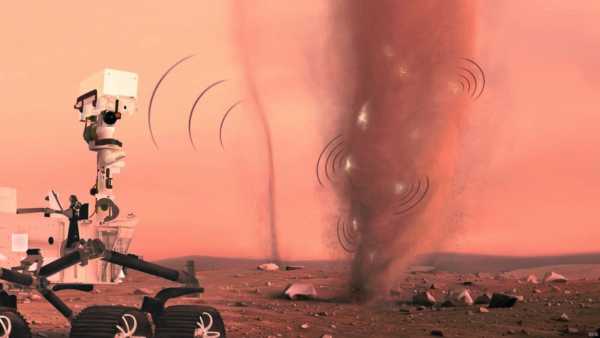
New Delhi: NASA’s Perseverance Rover has detected electric discharges on Mars from the first time, at the centre of two dust devils. The detection was made by the microphone on the SuperCam instrument carried by the Perseverance rover, which is the first to operate on Mars. The winds on Mars constantly stir up whirlwinds of the fine dust caking the surface, known as dust devils. These dust devils sweep across the surface of Mars. The recordings were analysed by scientists, with the detection having implications for improving the scientific understanding of the atmospheric chemistry of Mars, along with its climate and potential habitability.
The observations will benefit future crewed and robotic exploration of the Red Planet. The analysis by the scientists indicated that the electromagnetic and acoustic signatures were comparable to small electricity shocks that can be experienced on Earth when touching charged surfaces. Such electric discharges have been long suspected to exist in the atmosphere of the Red Planet, and has been confirmed through direct observation for the first time. The static electricity is explained by friction between the fine dust particles as they swirl around, they become charged with electrons that are released in the form of electric arcs a few centimetres in length, accompanied by audible shock waves.
Electric discharges alter atmosphere of Mars
On Earth, the dust particles can get electrically charged in desert regions, but rarely results in discharges. Mars has an atmosphere that is much thinner than the Earth, and is primarily composed of carbon dioxide. As a result, the amount of charge necessary to induce sparks is far lower than on Earth. The observations reveal that in the Martian atmosphere the charge can build up to sufficient levels to form highly oxidising compounds that can destroy organic molecules, break down atmospheric compounds, and alter the photochemical balance of the atmosphere. The discovery could also explain the surprisingly rapid scrubbing of methane from the Martian atmosphere, which has puzzled scientists for long. A paper describing the research has been published in Nature.
Contact to : xlf550402@gmail.com
Copyright © boyuanhulian 2020 - 2023. All Right Reserved.